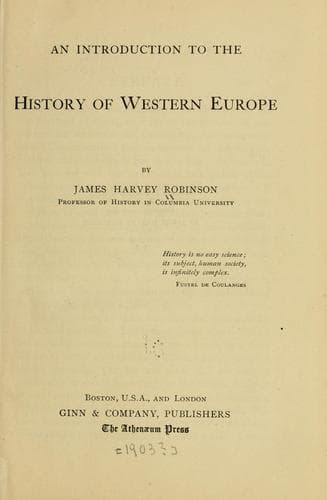
An Introduction to the History of Western EuropeRobinson, James Harvey
History
An Introduction to the History of Western Europe
Robinson, James Harvey
Europe -- History
Finally, however, in spite of the great strength and the wonderful
organization of the Church, it became apparent that it was no longer
possible to keep all of western Europe under the sway of the pope. In
the autumn of 1520, Professor Martin Luther called together the students
of the University of Wittenberg, led them outside the town walls, and
there burned the constitution and statutes of the mediæval Church, i.e.,
the canon law. In this way he publicly proclaimed and illustrated his
purpose to repudiate the existing Church with many of its doctrines and
practices. Its head he defied by destroying the papal bull directed
against his teachings.
[Sidenote: Origin of the two great religious parties in western
Europe,--the Catholics and Protestants.]
Other leaders, in Germany, Switzerland, England, and elsewhere,
organized separate revolts; rulers decided to accept the teachings of
the reformers, and used their power to promote the establishment of
churches independent of the pope. In this way western Europe came to be
divided into two great religious parties. The majority of its people
continued to regard the pope as their religious head and to accept the
institutions under which their forefathers had lived since the times of
Theodosius. In general, those regions (except England) which had formed
a part of the Roman empire remained Roman Catholic in their belief. On
the other hand, northern Germany, a part of Switzerland, England,
Scotland, and the Scandinavian countries sooner or later rejected the
headship of the pope and many of the institutions and doctrines of the
mediæval Church, and organized new religious institutions. The
Protestants, as those who seceded from the Church of Rome were called,
by no means agreed among themselves what particular system should
replace the old one. They were at one, however, in ceasing to obey the
pope and in proposing to revert to the early Church as their model and
accepting the Bible as their sole guide.[262]
[Sidenote: Revolt against the mediæval Church implied a general
revolution.]
To revolt against the Church was to inaugurate a fundamental revolution
in many of the habits and customs of the people. It was not merely a
change of religious belief, for the Church permeated every occupation
and dominated every social interest. For centuries it had directed and
largely controlled education, high and low. Each and every important act
in the home, in the guild, in the town, was accompanied by religious
ceremonies. The clergy of the Roman Catholic Church had hitherto written
most of the books; they sat in the government assemblies, acted as the
rulers' most trusted ministers, constituted, in short, outside of Italy,
the only really educated class. Their rôle and the rôle of the Church
were incomparably more important than that of any church which exists
to-day.
[Sidenote: The wars of religion.]
Public-domain text, read in full here on John Shaqi.
Reviews
Reviews
No reviews yet
Be the first to share your thoughts on this work.
Elsewhere in the archive
Join the Discussion
Join the discussion
Sign in to leave a comment or review.
Sign InorCreate an account