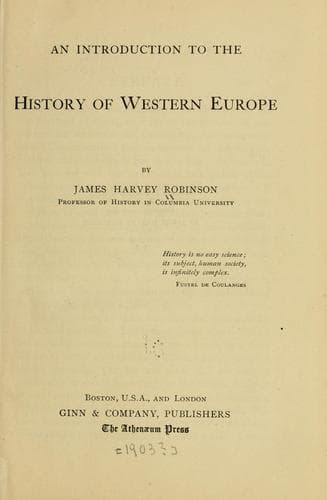
An Introduction to the History of Western EuropeRobinson, James Harvey
History
An Introduction to the History of Western Europe
Robinson, James Harvey
Europe -- History
These facts would seem to justify the conclusion that there were many
before Luther appeared who were approaching the ideas of religion which
later appealed especially to the Protestants. The insistence of the
Protestants upon salvation through faith alone in God, their suspicion
of ceremonies and "good works," their reliance upon the Bible, and the
stress they laid upon preaching,--all these were to be found in Germany
and elsewhere before Luther began to preach.
[Sidenote: The German humanists.]
[Sidenote: Rudolph Agricola, 1442-1485.]
138. Among the critics of the churchmen, monks, and theologians, none
were more conspicuous than the humanists. The Renaissance in Italy,
which may be said to have begun with Petrarch and his library, has
already been described. The Petrarch of Germany was Rudolph Agricola,
who, while not absolutely the first German to dedicate himself to
classical studies, was the first who by his charming personality and
varied accomplishments stimulated others, as Petrarch had done, to carry
on the pursuits which he himself so much enjoyed. Unlike most of the
Italian humanists, however, Agricola and his followers were interested
in the language of the people as well as in Latin and Greek; and
proposed that the works of antiquity should be translated into German.
Moreover, the German humanists were generally far more serious and
devout than the Italian scholars.
[Sidenote: The humanists desire to reform the German universities.]
As the humanists increased in numbers and confidence they began to
criticise the excessive attention given in the German universities[267]
to logic and the scholastic theology. These studies had lost their
earlier vitality[268] and had degenerated into fruitless disputations.
The bad Latin which the professors used themselves and taught their
students, and the preference still given to Aristotle over all other
ancient writers, disgusted the humanists. They therefore undertook to
prepare new and better text-books, and proposed that the study of the
Greek and Roman poets and orators should be introduced into the schools
and colleges. Some of the classical scholars were for doing away with
theology altogether, as a vain, monkish study which only obscured the
great truths of religion. The old-fashioned professors, on their part,
naturally denounced the new learning, which they declared made pagans of
those who became enamored of it. Sometimes the humanists were permitted
to teach their favorite subjects in the universities, but as time went
on it became clear that the old and the new teachers could not work
amicably side by side.
[Sidenote: The humanist satire on the monks and theologians, the
so-called _Letters of Obscure Men_.]
Public-domain text, read in full here on John Shaqi.
Reviews
Reviews
No reviews yet
Be the first to share your thoughts on this work.
Elsewhere in the archive
Join the Discussion
Join the discussion
Sign in to leave a comment or review.
Sign InorCreate an account