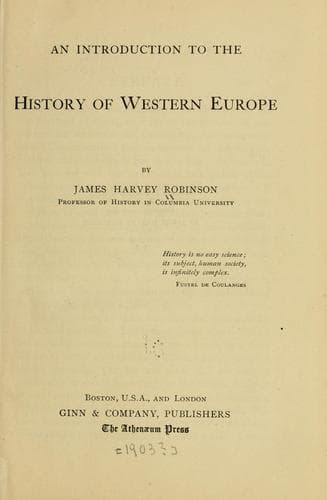
An Introduction to the History of Western EuropeRobinson, James Harvey
History
An Introduction to the History of Western Europe
Robinson, James Harvey
Europe -- History
Under the protection of the powerful Frankish mayor of the palace,
Charles Martel, Boniface carried on his missionary work with such zeal
that he succeeded in bringing all the older Christian communities which
had been established by the Irish missionaries under the papal control,
as well as in converting many of the more remote German tribes who
still clung to their old pagan beliefs. His energetic methods are
illustrated by the story of how he cut down the sacred oak of Odin at
Fritzlar, in Hesse, and used the wood to build a chapel, around which a
monastery soon grew up. In 732 Boniface was raised to the dignity of
Archbishop of Mayence and proceeded to establish, in the newly converted
region, the German bishoprics of Salzburg, Regensburg, Würzburg, Erfurt,
and several others; this gives us some idea of the geographical extent
of his labors.
[Sidenote: Boniface reforms the church in Gaul and brings it into
subjection to the pope.]
After organizing the German church he turned his attention, with the
hearty approval of the pope and the support of the Frankish rulers, to a
general reformation of the church in Gaul. Here the clergy were sadly
demoralized, and the churches and monasteries had been despoiled of much
of their property in the constant turmoil of the time. Boniface
succeeded, with the help of Charles Martel, in bettering affairs, and
through his efforts the venerable church of Gaul, almost as old as that
of Rome itself, was brought under the supremacy of the pope. In 748 the
assembled bishops of Gaul bound themselves to maintain the Catholic
unity of faith and follow strictly the precepts of the vicar of St.
Peter, the pope, so that they might be reckoned among Peter's sheep.
General Reading.--The best history of the monks to be had in
English is MONTALEMBERT, _The Monks of the West from St. Benedict
to St. Bernard_ (Longmans, Green & Co., 6 vols., $15.00). The
writer's enthusiasm and his excellent style make his work very
attractive. The advanced student will gain much from TAYLOR,
_Classical Heritage of the Middle Ages_ (The Macmillan Company,
$1.75), Chapter VII, on the origin and spirit of monasticism. See
also HARNACK, _Monasticism_ (Scribners, 50 cents). The works on
church history referred to at the end of the preceding chapter all
contain some account of the monks.
CHAPTER VI
CHARLES MARTEL AND PIPPIN
[Sidenote: Charles Martel, Frankish mayor of the palace, 714-741.]
24. Just as the pope was becoming the acknowledged head of the Western
Church, the Frankish realms came successively under the rule of two
great statesmen, Charles Martel and his son Pippin the Short, who laid
the foundation of Charlemagne's vast empire.
[Sidenote: Difficulty of holding together a kingdom in the early Middle
Ages.]
Public-domain text, read in full here on John Shaqi.
Reviews
Reviews
No reviews yet
Be the first to share your thoughts on this work.
Join the Discussion
Join the discussion
Sign in to leave a comment or review.
Sign InorCreate an account