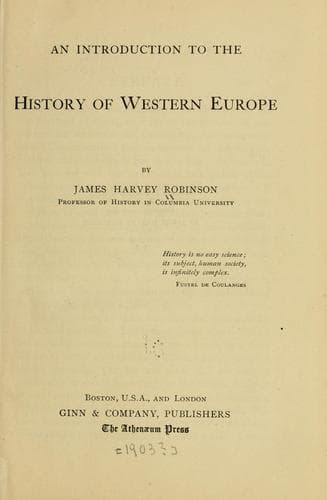
An Introduction to the History of Western EuropeRobinson, James Harvey
History
An Introduction to the History of Western Europe
Robinson, James Harvey
Europe -- History
The difficulties which Charles Martel had to face were much the same as
those which for centuries to follow confronted the sovereigns of western
Europe. The great problem of the mediæval ruler was to make his power
felt throughout his whole territory in spite of the many rich and
ambitious officials, bishops, and abbots who eagerly took advantage of
all the king's weaknesses and embarrassments to make themselves
practically supreme in their respective districts.
[Sidenote: Origin of counts and dukes.]
The two classes of officers of which we hear most were the counts
(Latin, _comites_) and the dukes (Latin, _duces_). A count ordinarily
represented the king within the district comprised in an old
municipality of the Empire. Over a number of counts the king might place
a duke. Both of these titles were borrowed by the Germans from the names
of Roman officials. While the king appointed, and might dismiss, these
officers when he pleased, there was a growing tendency for them to hold
their positions for life.
We find Charles fighting the dukes of Aquitaine, Bavaria, and Alemannia,
each of whom was endeavoring to make the territory which he was deputed
to rule in the king's interest a separate and independent country under
his own supremacy. By successive campaigns against these rebellious
magnates, Charles succeeded in reuniting all those outlying districts
that tended to forget or ignore their connection with the Frankish
empire.
[Sidenote: Charles and his bishops.]
The bishops proved almost, if not quite, as troublesome to the mayor of
the palace as the dukes, and later the counts. It is true that Charles
kept the choice of the bishops in his own hands and refused to give to
the clergy and people of the diocese the privilege of electing their
head, as the rules of the Church prescribed. But when a bishop had once
got possession of the lands attached to the bishopric and exercised the
wide powers and influence which fell to him, he was often tempted,
especially if he were a nobleman, to use his privileged position to
establish a practically independent principality. The same was true of
the heads of powerful monasteries. These dangerous bishops and abbots
Charles deposed in wholesale fashion. He substituted his own friends for
them with little regard to the rules of the Church--for instance, he
bestowed on his nephew the three bishoprics of Paris, Rouen, and Bayeux,
besides two monasteries. The new incumbents were, however, no better
than the old; they were, indeed, in spite of their clerical robes, only
laymen, who continued to fight and hunt in their customary manner.
The most famous of Charles' deeds was his decisive defeat of the
advancing Mohammedans who were pressing into Gaul from Spain. Before
speaking of this a word must be said of the invaders and their religion,
for the Saracens, as the followers of Mohammed were commonly called,
will come into our story of western Europe now and then, especially
during the Crusades.
Public-domain text, read in full here on John Shaqi.
Reviews
Reviews
No reviews yet
Be the first to share your thoughts on this work.
Join the Discussion
Join the discussion
Sign in to leave a comment or review.
Sign InorCreate an account