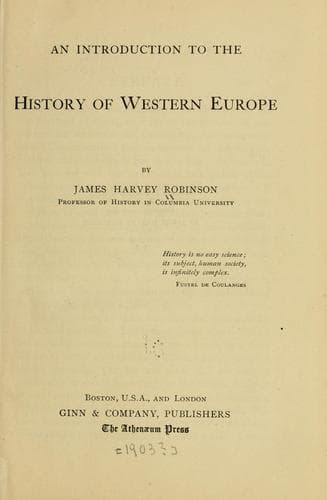
An Introduction to the History of Western EuropeRobinson, James Harvey
History
An Introduction to the History of Western Europe
Robinson, James Harvey
Europe -- History
The kingdom of the West Goths was in no condition to defend itself when
a few Arabs and a much larger number of Berbers, inhabitants of northern
Africa, ventured to cross over. Some of the Spanish towns held out for a
time, but the invaders found allies in the numerous Jews who had been
shamefully treated by their Christian countrymen. As for the innumerable
serfs who worked on the great estates of the aristocracy, a change of
landlords made very little difference to them. In 711 the Arabs and
Berbers gained a great battle, and the peninsula was gradually overrun
by new immigrants from Africa. In seven years the Mohammedans were
masters of almost the whole region south of the Pyrenees. They then
began to cross into Gaul and took possession of the district about
Narbonne. For some years the duke of Aquitaine kept them in check, but
in 732 they collected a large army, defeated the duke near Bordeaux,
advanced to Poitiers, where they burned the church, and then set out for
Tours.
[Sidenote: Battle of Tours, 732.]
Charles Martel at once sent out a summons to all who could bear arms
and, in the same year, met and repulsed the Mohammedans near Tours. We
know very little indeed of the details of the conflict, but it is
certain that the followers of Mohammed retreated and that they never
made another attempt to conquer western Europe.
[Sidenote: Pippin and Carloman.]
[Sidenote: Abdication of Carloman.]
26. Charles was able, before his death in 741, to secure the succession
to his office of mayor of the palace for his two sons, Pippin and
Carloman. The brothers left the nominal king on the throne; but he had
nothing to do, as the chronicler tells us, "but to be content with his
name of king, his flowing hair and long beard; to sit on his throne and
play the ruler, listening to the ambassadors who came from all
directions, and giving them the answers that had been taught him, as if
of his own sovereign will. In reality, however, he had nothing but the
royal name and a beggarly income at the will of the mayor of the
palace." The new mayors had succeeded in putting down all opposition
when, to the astonishment of every one, Carloman abdicated and assumed
the gown of a monk. Pippin took control of the whole Frankish dominion,
and we find the unusual statement in the Frankish annals that "the whole
land enjoyed peace for two years" (749-750).
[Sidenote: Pippin assumes the crown with the approbation of the pope,
752.]
Public-domain text, read in full here on John Shaqi.
Reviews
Reviews
No reviews yet
Be the first to share your thoughts on this work.
Elsewhere in the archive
Join the Discussion
Join the discussion
Sign in to leave a comment or review.
Sign InorCreate an account