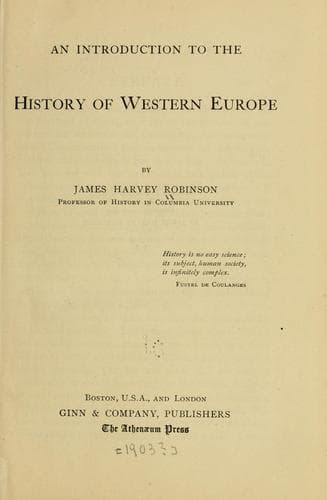
An Introduction to the History of Western EuropeRobinson, James Harvey
History
An Introduction to the History of Western Europe
Robinson, James Harvey
Europe -- History
Pippin now felt himself strong enough to get rid of the "do-nothing"
king altogether and assume for himself the nominal as well as the real
kingship of the Franks. It was, however, a delicate matter to depose
even a quite useless monarch, so he determined to consult the head of
the Church. To Pippin's query whether it was fitting that the
Merovingian king of the Franks, having no power, should continue to
reign, the pope replied: "It seems better that he who has the power in
the state should be king and be called king, rather than he who is
falsely called king."
It will be noticed that the pope in no sense created Pippin king, as
later writers claimed. He sanctioned a usurpation which was practically
inevitable and which was carried out with the approbation of the
Frankish nation. Raised on the shields of the counts and dukes, anointed
by St. Boniface, and blessed by the pope, Pippin became in 752 the first
king of the Carolingian family, which had already for several
generations ruled the Franks in all but name.
[Sidenote: A new theory of kingship.]
This participation of the pope brought about a very fundamental change
in the theory of kingship. The kings of the Germans up to this time had
been military leaders selected, or holding their office, by the will of
the people, or at least of the aristocracy. Their rule had had no divine
sanction, but only that of general acquiescence backed up by sufficient
skill and popularity to frustrate the efforts of rivals. By the
anointing of Pippin in accordance with the ancient Jewish custom, first
by St. Boniface and then by the pope himself, "a German chieftain was,"
as Gibbon expresses, it "transformed into the Lord's anointed." The pope
uttered a dire anathema of divine vengeance against any one who should
attempt to supplant the holy and meritorious race of Pippin. It became a
_religious_ duty to obey the king. He came to be regarded by the Church,
when he had duly received its sanction, as God's representative on
earth. Here we have the basis of the later idea of monarchs "by the
grace of God," against whom, however bad they might be, it was not
merely a political offense, but a sin, to revolt.
27. The sanction of Pippin's usurpation by the pope was but an
indication of the good feeling between the two greatest powers in the
West,--the head of the ever-strengthening Frankish state and the head of
the Church. This good feeling quickly ripened into an alliance,
momentous for the history of Europe. In order to understand this we must
glance at the motives which led the popes to throw off their allegiance
to their ancient sovereigns, the emperors at Constantinople, and turn
for help to Pippin and his successors.
[Sidenote: Controversy over the veneration of images and pictures,--the
so-called iconoclastic controversy.]
Public-domain text, read in full here on John Shaqi.
Reviews
Reviews
No reviews yet
Be the first to share your thoughts on this work.
Elsewhere in the archive
Join the Discussion
Join the discussion
Sign in to leave a comment or review.
Sign InorCreate an account