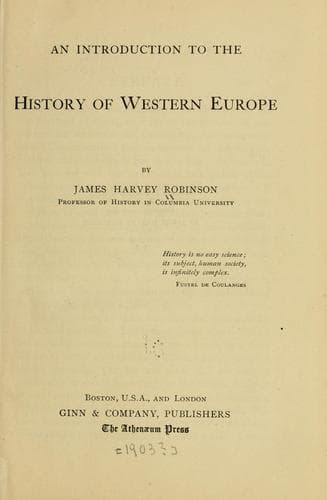
An Introduction to the History of Western EuropeRobinson, James Harvey
History
An Introduction to the History of Western Europe
Robinson, James Harvey
Europe -- History
The impression which his reign made upon men's minds grew even after his
death. He became the hero of a whole cycle of romantic but wholly
unhistoric adventures and achievements which were as devoutly believed
for centuries as his most authentic deeds. In the fancy of an old monk
in the monastery of St. Gall,[40] writing of Charlemagne not long after
his death, the king of the Franks swept over Europe surrounded by
countless legions of soldiers who formed a very sea of bristling steel.
Knights of superhuman valor formed his court and became the models for
the chivalrous spirit of the following centuries. Distorted but
imposing, the Charlemagne of poetry meets us all through the Middle
Ages.
A study of Charlemagne's reign will substantiate our first impression
that he was a truly remarkable person, one of the greatest figures in
the world's records and deservedly the hero of the Middle Ages. To few
men has it been given to influence so profoundly the course of European
progress. We shall consider him first as a conqueror, then as an
organizer and creator of governmental institutions, and lastly as a
promoter of culture and enlightenment.
[Sidenote: Charlemagne's idea of a great Christian empire.]
29. It was Charlemagne's ideal to bring all the German peoples together
into one great Christian empire, and he was wonderfully successful in
attaining his end. Only a small portion of what is now called Germany
was included in the kingdom ruled over by Pippin. Frisia and Bavaria had
been Christianized, and their native rulers had been induced by the
efforts of Charlemagne's predecessors and of the missionaries,
especially Boniface, to recognize formally the overlordship of the
Franks. Between these two half-independent countries lay the unconquered
Saxons. They were as yet pagans and appear to have still clung to much
the same institutions as those under which they lived when the Roman
historian Tacitus described them seven centuries earlier.
[Sidenote: The conquest of the Saxons.]
Public-domain text, read in full here on John Shaqi.
Reviews
Reviews
No reviews yet
Be the first to share your thoughts on this work.
Elsewhere in the archive
Join the Discussion
Join the discussion
Sign in to leave a comment or review.
Sign InorCreate an account