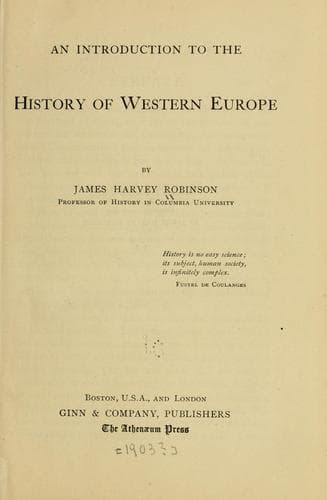
An Introduction to the History of Western EuropeRobinson, James Harvey
History
An Introduction to the History of Western Europe
Robinson, James Harvey
Europe -- History
The assumption of the title of emperor was destined to make the German
rulers a great deal of trouble. It constantly led them into futile
efforts to maintain a supremacy over Italy, which lay without their
natural boundaries. Then the circumstances under which Charlemagne was
crowned made it possible for the popes to claim, later, that it was they
who had transferred the imperial power from the old eastern line of
emperors to the Carolingian house, and that this was a proof of their
right to dispose of the crown as they pleased. The difficulties which
arose necessitated many a weary journey to Rome for the emperors, and
many unworthy conflicts between the temporal and spiritual heads of
Christendom.
[Sidenote: Charlemagne's system of government.]
33. The task of governing his vast and heterogeneous dominions taxed
even the highly gifted and untiring Charlemagne; it quite exceeded the
capacity of his successors. The same difficulties continued to exist
that had confronted Charles Martel and Pippin,--above all a scanty royal
revenue and over-powerful officials who were prone to neglect the
interests and commands of their sovereign. Charlemagne's distinguished
statesmanship is nowhere so clearly seen as in his measures for
extending his control to the very confines of his realms.
[Sidenote: Charlemagne's farms.]
His income, like that of all mediæval rulers, came chiefly from his
royal estates, as there was no system of general taxation such as had
existed under the Roman Empire. He consequently took the greatest care
that his numerous plantations should be well cultivated and that not
even a turnip or an egg which was due him should be withheld. An
elaborate set of regulations for his farms is preserved, which sheds
much light upon the times.[47]
[Sidenote: Origin of titles of nobility.]
The officials upon whom the Frankish kings were forced to rely chiefly
were the counts, the "hand and voice of the king" wherever he could not
be in person. They were to maintain order, see that justice was done in
their district, and raise troops when the king needed them. On the
frontier were the counts of the march, or margraves (marquises), already
mentioned. These titles, together with that of duke, still exist as
titles of nobility in Europe, although they are no longer associated
with governmental duties except where their holders have the right to
sit in the upper house of parliament.
[Sidenote: The _missi dominici_.]
To keep the counts in order, Charlemagne appointed royal commissioners
(the _missi dominici_), whom he dispatched to all parts of his realm to
investigate and report to him how things were going in the districts
assigned to them. They were sent in pairs, a bishop and a layman, so
that they might act as a check on one another. Their circuits were
changed each year so that they should have no chance to enter into
conspiracy with the counts whom it was their special business to
watch.[48]
Public-domain text, read in full here on John Shaqi.
Reviews
Reviews
No reviews yet
Be the first to share your thoughts on this work.
Elsewhere in the archive
Join the Discussion
Join the discussion
Sign in to leave a comment or review.
Sign InorCreate an account