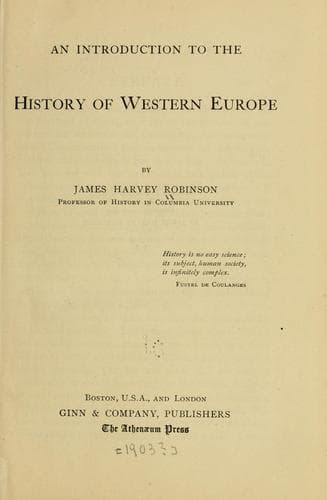
An Introduction to the History of Western EuropeRobinson, James Harvey
History
An Introduction to the History of Western Europe
Robinson, James Harvey
Europe -- History
It would be impossible to say how many of the innumerable abbots and
bishops established schools in accordance with Charlemagne's
recommendations. It is certain that famous centers of learning existed
at Tours, Fulda, Corbie, Orleans, and other places during his reign.
Charlemagne further promoted the cause of education by the establishment
of the famous "school of the palace" for the instruction of the sons of
his nobles and of his own children. He placed the Englishman, Alcuin, at
the head of the school, and called distinguished men from Italy and
elsewhere as teachers. The best known of these was the historian, Paulus
Diaconus, who wrote a history of the Lombards, to which we owe most of
what we know about them.
Charlemagne appears to have been particularly impressed with the
constant danger of mistakes in copying books, a task frequently turned
over to ignorant and careless persons. After recommending the founding
of schools, he continues: "Correct carefully the Psalms, the signs used
in music, the [Latin] grammar, and the religious books used in every
monastery or bishopric; since those who desire to pray to God properly
often pray badly because of the incorrect books. And do not let your
boys misread or miswrite them. If there is any need to copy the Gospel,
Psalter or Missal, let men of maturity do the writing with great
diligence." These precautions were amply justified, for a careful
transmission of the literature of the past was as important as the
attention to education. It will be noted that Charlemagne made no
attempt to revive the learning of Greece and Rome. He deemed it quite
sufficient if the churchmen would learn their Latin well enough to read
the missal and the Bible intelligently.
The hopeful beginning that was made under Charlemagne in the revival of
education and intellectual interest was destined to prove disappointing
in its immediate results. It is true that the ninth century produced a
few noteworthy men who have left works which indicate acuteness and
mental training. But the break-up of Charlemagne's empire, the struggles
between his descendants, the coming of new barbarians, and the disorder
caused by the unruly feudal lords, who were not inclined to recognize
any master, all conspired to keep the world back for at least two
centuries more. Indeed, the tenth and the first half of the eleventh
centuries seem, at first sight, little better than the seventh and
eighth. Yet ignorance and disorder never were quite so prevalent after,
as they were before, Charlemagne.
General Reading.--The best life of Charlemagne in English is
MOMBERT, _A History of Charles the Great_ (D.C. Appleton & Co.,
$5.00). See also HODGKIN, _Charles the Great_ (The Macmillan
Company, 75 cents), and WEST, _Alcuin_ (Charles Scribner's Sons,
$1.00).
CHAPTER VIII
THE DISRUPTION OF CHARLEMAGNE'S EMPIRE
[Sidenote: Louis the Pious succeeds Charlemagne.]
Public-domain text, read in full here on John Shaqi.
Reviews
Reviews
No reviews yet
Be the first to share your thoughts on this work.
Elsewhere in the archive
Join the Discussion
Join the discussion
Sign in to leave a comment or review.
Sign InorCreate an account