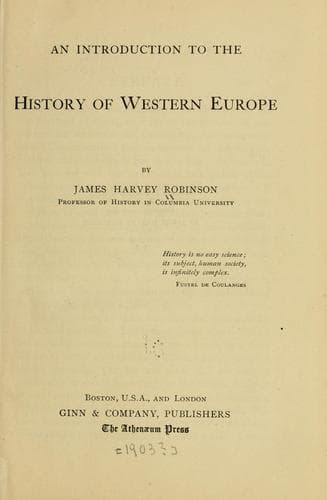
An Introduction to the History of Western EuropeRobinson, James Harvey
History
An Introduction to the History of Western Europe
Robinson, James Harvey
Europe -- History
The map of Great Britain at the accession of William the Conqueror has
the same three great divisions which exist to-day. The little kingdoms
had disappeared and England extended north to the Tweed, which separated
it, as it now does, from the kingdom of Scotland. On the west was Wales,
inhabited then, as it is still, by descendants of the native Britons, of
whom only a small remnant had survived the German invasions. The Danes
had been absorbed into the mass of the population and all England
recognized a single king. The king's power had increased as time went
on, although he was bound to act in important matters only with the
consent of a council (Witenagemot) made up of high royal officials,
bishops, and nobles. The kingdom was divided into shires,[85] as it
still is, and each of these had a local assembly, a sort of parliament
for the dispatch of local matters.
After the victory of the papal party at the Council of Whitby,[86] the
Church had been thoroughly organized and the intercourse of the clergy
with the continent served, as we have seen, to keep England from
becoming completely isolated. Although the island was much behind some
other portions of Europe in civilization, the English had succeeded in
laying the foundations for the development of a great nation and an
admirable form of government.
[Sidenote: Feudalism in England.]
England was not, however, to escape feudalism. The Normans naturally
brought with them their own feudal institutions, but even before their
coming many suggestions of feudalism might have been discovered. Groups
of shires had been placed under the government of earls who became
dangerous rivals of the kings; and the habit of giving churchmen the
right to govern, to a large extent, those who lived upon their vast
estates recalls the conditions in the Frankish empire during the same
period. The great landed proprietor in England exercised much the same
powers over those about him that the feudal lords enjoyed upon the other
side of the Channel.
[Sidenote: The struggle for the English crown between Earl Harold and
Duke William of Normandy.]
52. As has been said, William of Normandy claimed that he was entitled
to the English crown; he even assumed that all who refused to
acknowledge him in England were traitors. We are, however, somewhat in
the dark as to the basis of his claim. There is a story that he had
visited the court of Edward the Confessor and had become his vassal on
condition that, should Edward die childless, he was to designate William
as his successor. But Harold, Earl of Wessex, who had consolidated his
power before the death of Edward by securing the appointment of his
brothers to three of the other great earldoms, assumed the crown and
paid no attention to William's demand that he should surrender it.
[Sidenote: The pope favors William's claim.]
[Sidenote: Battle of Senlac, 1066. William I crowned at London.]
Public-domain text, read in full here on John Shaqi.
Reviews
Reviews
No reviews yet
Be the first to share your thoughts on this work.
Elsewhere in the archive
Join the Discussion
Join the discussion
Sign in to leave a comment or review.
Sign InorCreate an account