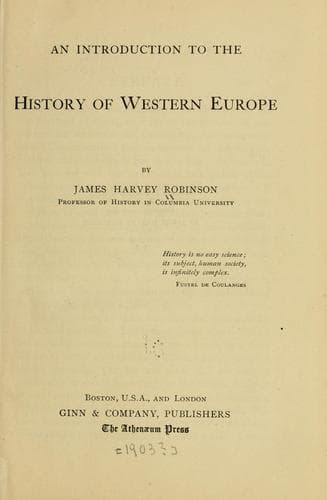
An Introduction to the History of Western EuropeRobinson, James Harvey
History
An Introduction to the History of Western Europe
Robinson, James Harvey
Europe -- History
William declared that he did not propose to change the English customs
but to govern as Edward the Confessor, the last Saxon king whom he
acknowledged, had done. He tried to learn English, maintained the
Witenagemot, and observed English practices. But he was a man of too
much force to submit to the control of his people. While he appointed
counts or earls in some of the shires (now come to be called
_counties_), he controlled them by means of other royal officers called
_sheriffs_. He avoided giving to any one person a great many estates in
a single region, so that no one should become inconveniently powerful.
Finally, in order to secure the support of the smaller landholders and
to prevent combinations against him among the greater ones, he required
every landholder in England to take an oath of fidelity directly to him.
We read in the _Anglo-Saxon Chronicle_ (1086): "After that he went about
so that he came, on the first day of August, to Salisbury, and there
came to him his wise men [i.e., counselors], and all the landowning men
of property there were over all England, whosesoever men they were; and
all bowed down to him and became his men, and swore oaths of fealty to
him that they would be faithful to him against all other men."
[Sidenote: Domesday Book.]
William's anxiety to have a complete knowledge of his whole kingdom is
indicated by a remarkable historical document, the so-called _Domesday
Book_. This is a register of the lands throughout England, indicating
the value of each parcel, the serfs and stock upon it, the name of its
holder and of the person who held it before the Conquest. This
government report contained a vast amount of information which was
likely to prove useful to William's taxgatherers. It is still valuable
to the historian, although unfortunately he is not able in every case to
interpret its terms satisfactorily.
[Sidenote: William the Conqueror and the Church.]
William's policy in regard to the Church indicates a desire to advance
its interests in conjunction with his own. He called Lanfranc, an
Italian who had been at the head of the famous monastery of Bec in
Normandy, to the archbishopric of Canterbury. The king permitted the
clergy to manage their own affairs and established bishops' courts to
try a variety of cases. But homage was exacted from a bishop as from a
lay vassal, and William refused to permit the pope to interfere in
English affairs without his permission in each particular case. No papal
legate was to enter the land without the king's sanction. No papal
decree should be received in the English Church without his consent, nor
his servants be excommunicated against his will. When Gregory VII
demanded that he should become his vassal for the land that he had
conquered under the papal auspices, William promptly refused.
[Sidenote: General results of the Norman Conquest.]
Public-domain text, read in full here on John Shaqi.
Reviews
Reviews
No reviews yet
Be the first to share your thoughts on this work.
Elsewhere in the archive
Join the Discussion
Join the discussion
Sign in to leave a comment or review.
Sign InorCreate an account