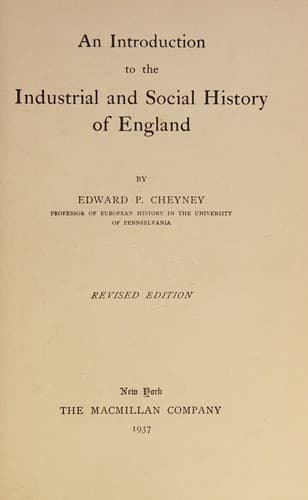
An Introduction to the Industrial and Social History of EnglandCheyney, Edward Potts
History
An Introduction to the Industrial and Social History of England
Cheyney, Edward Potts
Great Britain -- Economic conditions; Great Britain -- Maps; Industries -- Great Britain
But the increase in the number of these unorganized laborers, these
craftsmen and traders not under the control of the gilds, was most
marked in the rural districts, that is to say, in market towns and in
villages entirely outside of the old manufacturing and trading
centres. Even in the fourteenth century there were a number of
weavers, and probably of other craftsmen, who worked in the villages
in the vicinity of the larger towns, such as London, Norwich, and
York, and took their products to be sold on fair or market days in
these towns. But toward the end of the fifteenth century this rural
labor received a new kind of encouragement and a corresponding
extension far beyond anything before existing. The English
cloth-making industry at this period was increasing rapidly. Whereas
during the earlier periods, as we have seen, wool was the greatest of
English exports, now it was coming to be manufactured within the
country. In connection with this manufacture a new kind of industrial
organization began to show itself which, when it was completed,
became known as the "domestic system." A class of merchants or
manufacturers arose who are spoken of as "clothiers," or "merchant
clothiers," who bought the wool or other raw material, and gave it out
to carders or combers, spinners, weavers, fullers, and other
craftsmen, paying them for their respective parts in the process of
manufacture, and themselves disposing of the product at home or for
export. The clothiers were in this way a new class of employers,
putting the master weavers or other craftsmen to work for wages. The
latter still had their journeymen and apprentices, but the initiative
in their industry was taken by the merchants, who provided the raw
material and much of the money capital, and took charge of the sale of
the completed goods. The craftsmen who were employed in this form of
industry did not usually dwell in the old populous and wealthy towns.
It is probable that the restrictions of the gild ordinances were
disadvantageous both to the clothiers and to the small master
craftsmen, and that the latter, as well as journeymen who had no
chance to obtain an independent position, now that the town craft
organizations were under the control of the more wealthy members, were
very ready to migrate to rural villages. Thus, in as far as the
weaving industry was growing up under the management of the employing
clothiers, it was slipping out from under the control of the town
gilds by its location in the country. The same thing occurred in other
cases, even without the intermediation of a new employing class. We
hear of mattress makers, of rope makers, of tile makers, and other
artisans establishing themselves in the country villages outside of
the towns, where, as a law of 1495 says, "the wardens have no power or
authority to make search." In certain parts of England, in the
southwest, the west, and the northwest, independent weavers now set up
Public-domain text, read in full here on John Shaqi.
Reviews
Reviews
No reviews yet
Be the first to share your thoughts on this work.
Elsewhere in the archive
Join the Discussion
Join the discussion
Sign in to leave a comment or review.
Sign InorCreate an account