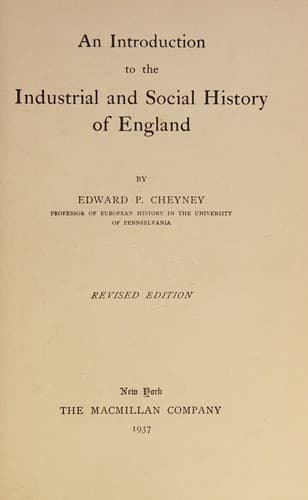
An Introduction to the Industrial and Social History of EnglandCheyney, Edward Potts
History
An Introduction to the Industrial and Social History of England
Cheyney, Edward Potts
Great Britain -- Economic conditions; Great Britain -- Maps; Industries -- Great Britain
merchants, and popular opinion no longer disapproved of it if the rate
was moderate.
*47. Paternal Government.*--In many of the changes which have been
described in this chapter, the share which government took was one of
the most important influences. In some cases, as in the laws against
enclosures, against the migration of industry from the towns to the
rural districts, and against usury, the policy of King and Parliament
was not successful in resisting the strong economic forces which were
at work. In others, however, as in the oversight of industry, in the
confiscation of the property of the gilds devoted to religious uses,
in the settlement of the relations between employers and employees, in
the control of foreign commerce, the policy of the government really
decided what direction changes should take.
As has been seen in this chapter, after the accession of Henry VII
there was a constant extension of the sphere of government till it
came to pass laws upon and provide for and regulate almost all the
economic interests of the nation. This was a result, in the first
place, of the breaking down of those social institutions which had
been most permanent and stable in earlier periods. The manor system in
the country, landlord farming, the manor courts, labor dues, serfdom,
were passing rapidly away; the old type of gilds, city regulations,
trading at fairs, were no longer so general; it was no longer
foreigners who brought foreign goods to England to be sold, or bought
English goods for exportation. When these old Customs were changing or
passing away, the national government naturally took charge to prevent
the threatened confusion of the process of disintegration. Secondly,
the government itself, from the latter part of the fifteenth century
onward, became abler and more vigorous, as has been pointed out in the
first paragraph of this chapter. The Privy Council of the king
exercised larger functions, and extended its jurisdiction into new
fields. Under these circumstances, when the functions of the central
government were being so widely extended, it was altogether natural
that they should come to include the control of all forms of
industrial life, including agriculture, manufacturing, commerce,
internal trade, labor, and other social and economic relations.
Thirdly, the control of economic and social matters by the government
was in accordance with contemporary opinions and feelings. An
enlightened absolutism seems to have commended itself to the most
thoughtful men of that time. A paternalism which regulated a very wide
circle of interests was unhesitatingly accepted and approved. As a
result of the decay of mediaeval conditions, the strengthening of
national government, and the prevailing view of the proper functions
of government, almost all economic conditions were regulated by the
government to a degree quite unknown before. In the early part of the
period this regulation was more minute, more intrusive, more evidently
Public-domain text, read in full here on John Shaqi.
Reviews
Reviews
No reviews yet
Be the first to share your thoughts on this work.
Elsewhere in the archive
Join the Discussion
Join the discussion
Sign in to leave a comment or review.
Sign InorCreate an account