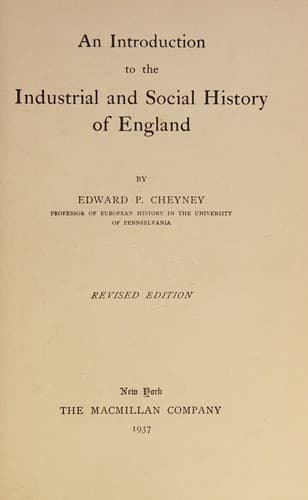
An Introduction to the Industrial and Social History of EnglandCheyney, Edward Potts
History
An Introduction to the Industrial and Social History of England
Cheyney, Edward Potts
Great Britain -- Economic conditions; Great Britain -- Maps; Industries -- Great Britain
The foreign lands with which these companies traded furnished at the
beginning of this period the only places to which goods could be
exported and from which goods could be brought; but very soon that
series of settlements of English colonists was begun, one of the
principal inducements for which was that they would furnish an outlet
for English goods. The "Plantation of Ulster," or introduction of
English and Scotch settlers into the north of Ireland between 1610 and
1620, was the beginning of a long process of immigration into that
country. But far the most important plantations as an outlet for trade
as in every respect were those made on the coast of North America and
in the West Indies. The Virginia and the Plymouth Companies played a
part in the early settlement of these colonies, but they were soon
superseded by the crown, single proprietaries, or the settlers
themselves. Virginia, New England, Maryland, the Carolinas, and
ultimately New York, Pennsylvania, and Georgia on the mainland; the
islands of Bermudas, Barbadoes, and Jamaica, and ultimately Canada,
came to be populous colonies inhabited by Englishmen and demanding an
ever increasing supply of English manufactured goods. These colonies
were controlled by the English government largely for their commercial
and other forms of economic value. The production of goods needed in
England but not produced there, such as sugar, tobacco, tar, and
lumber, was encouraged, but the manufacture of such goods as could be
exported from England was prohibited. The purchase of slaves in Africa
and their exportation to the West Indies was encouraged, partly
because they were paid for in Africa by English manufactured goods,
partly because their use in the colonies made the supply of sugar and
some other products plentiful and cheap.
Closely connected with commerce and colonies as a means of disposing
of England's manufactured goods and of obtaining those things which
were needed from abroad was commerce for its own sake, for the profits
which it brought to those engaged in it, and for the indirect value to
the nation of having a large mercantile navy.
Public-domain text, read in full here on John Shaqi.
Reviews
Reviews
No reviews yet
Be the first to share your thoughts on this work.
Elsewhere in the archive
Join the Discussion
Join the discussion
Sign in to leave a comment or review.
Sign InorCreate an account