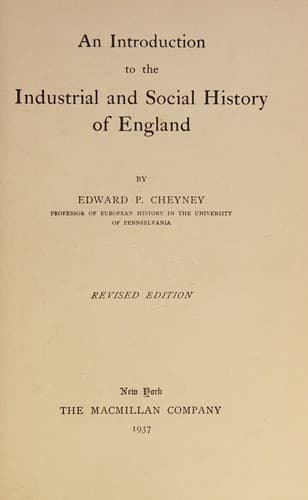
An Introduction to the Industrial and Social History of EnglandCheyney, Edward Potts
History
An Introduction to the Industrial and Social History of England
Cheyney, Edward Potts
Great Britain -- Economic conditions; Great Britain -- Maps; Industries -- Great Britain
It was pointed out, for instance, that because of the limited amount
of capital in existence at any one time, "a demand for commodities is
not a demand for labor;" and therefore a law like that which required
burial in a woollen shroud did not give added occupation to the
people, but only diverted them from one occupation to another. Ricardo
developed a law of wages to the effect that they always tend to the
amount "necessary to enable the laborer to subsist, and to perpetuate
his race without either increase or diminution," and that any
artificial raising or lowering of wages is impossible, or else causes
an increase or diminution in their number which, through competition,
soon brings back the old rate. Rent was also explained by Ricardo as
arising from the differences of quality between different pieces of
land, and as measured by the difference in the productivity of the
land under consideration and that of the poorest land under
cultivation at the time; and therefore being in its amount independent
of direct human control. The Malthusian law of population showed that
population tended to increase in a geometrical ratio, subsistence for
the population, on the other hand, only in an arithmetical ratio, and
that poverty was, therefore, the natural and inevitable result in old
countries of a pressure of population on subsistence. The sanction of
science was thus given alike to the desires of the lovers of freedom
and to the regrets of those who deplored man's departure from the
state of nature.
All these intellectual tendencies and reasonings of the later
eighteenth century, therefore, combined to discredit the minute
regulation of economic society, which had been the traditional policy
of the immediately preceding centuries. The movement of thought was
definitely opposed to the continuance or extension of the supervision
of the government over matters of labor, wages, hours, industry,
commerce, agriculture, or other phenomena of production, distribution,
exchange, or consumption. This set of opinions is known as the
_laissez-faire_ theory of the functions of government, the view that
the duties of government should be reduced to the smallest possible
number, and that it should keep out of the economic sphere altogether.
Adam Smith would have restricted the functions of government to three:
to protect the nation from the attacks of other nations, to protect
each person in the nation from the injustice or violence of other
individuals, and to carry on certain educational or similar
institutions which were of general utility, but not to any one's
private interest. Many of his successors would have cut off the last
duty altogether.
Public-domain text, read in full here on John Shaqi.
Reviews
Reviews
No reviews yet
Be the first to share your thoughts on this work.
Elsewhere in the archive
Join the Discussion
Join the discussion
Sign in to leave a comment or review.
Sign InorCreate an account