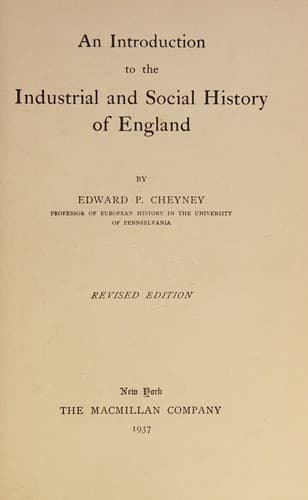
An Introduction to the Industrial and Social History of EnglandCheyney, Edward Potts
History
An Introduction to the Industrial and Social History of England
Cheyney, Edward Potts
Great Britain -- Economic conditions; Great Britain -- Maps; Industries -- Great Britain
again, if tried now, was evident. It was an effort to alter the action
of the natural laws which controlled employment, wages, profits, and
other economic matters, and was bad in theory, and would therefore
necessarily be injurious in practice. These and some other less
general arguments were used over and over again in the various forms
of the discussion through almost half a century. The laws that were
passed were carried because the majority in Parliament were either not
convinced by these reasonings or else determined that, come what
might, the evils and abuses connected with factory labor should be
abolished. As a matter of fact, the factory laws were carried by the
rank and file of the voting members of Parliament, not only against
the protests of the manufacturers especially interested, but in spite
of the warnings of those who spoke in the name of established
teaching, and frequently against the opposition of the political
leaders of both parties. The greatest number of those who voted for
them were influenced principally by their sympathies and feelings, and
yielded to the appeals of certain philanthropic advocates, the most
devoted and influential of whom was Lord Ashley, afterward earl of
Shaftesbury, who devoted many years to investigation and agitation on
the subject both inside and out of Parliament.
*69. Factory Legislation to 1847.*--The actual course of factory
legislation was as follows. The bill originally introduced in 1815,
after having been subjected to a series of discussions, amendments,
and postponements, was passed in June, 1819, being the second "Factory
Act." It applied only to cotton mills, and was in the main merely an
extension of the act of 1802 to the protection of children who were
not pauper apprentices. It forbade the employment of any child under
nine years of age, and prohibited the employment of those between nine
and sixteen more than twelve hours a day, or at night. In addition to
the twelve hours of actual labor, at least a half-hour must be allowed
for breakfast and an hour for dinner. Other minor acts amending or
extending this were passed from time to time, till in 1833, after two
successive commissions had made investigations and reports on the
subject, an important law was passed. It applied practically to all
textile mills, not merely to those for the spinning of cotton. The
prohibition of employment of all below nine years was continued,
children between nine and thirteen were to work only eight hours per
day, and young persons between thirteen and eighteen only twelve
hours, and none of these at night. Two whole and eight half holidays
were required to be given within the year, and each child must have a
surgeon's certificate of fitness for labor. There were also clauses
for the education of the children and the cleanliness of the
factories. But the most important clause of this statute was the
provision of a corps of four inspectors with assistants who were sworn
Public-domain text, read in full here on John Shaqi.
Reviews
Reviews
No reviews yet
Be the first to share your thoughts on this work.
Elsewhere in the archive
Join the Discussion
Join the discussion
Sign in to leave a comment or review.
Sign InorCreate an account