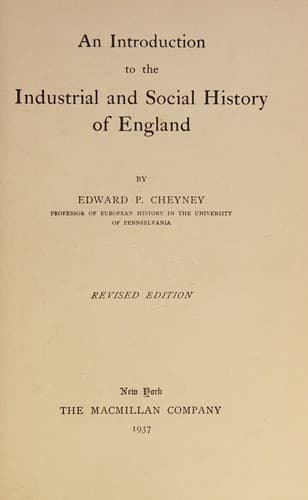
An Introduction to the Industrial and Social History of EnglandCheyney, Edward Potts
History
An Introduction to the Industrial and Social History of England
Cheyney, Edward Potts
Great Britain -- Economic conditions; Great Britain -- Maps; Industries -- Great Britain
period of their legal growth and development now began,
notwithstanding the narrow field of activity allowed them by the law
as it then stood. Combinations were continually formed for further
objects, and prosecutions, either under the statute or under Common
Law, were still very numerous. In 1859 a further change in the law was
made, by which it became lawful to combine to demand a change of wages
or hours, even if the action involved other persons than those taking
part in the agreement, and to exercise peaceful persuasion upon others
to join the strikers in their action. Within the bounds of the limited
legal powers granted by the laws of 1825 and 1859, large numbers of
trade unions were formed, much agitation carried on, strikes won and
lost, pressure exerted upon Parliament, and the most active and
capable of the working classes gradually brought to take an interest
in the movement. This growth was unfortunately accompanied by much
disorder. During times of industrial struggle non-strikers were
beaten, employers were assaulted, property was destroyed, and in
certain industrial communities confusion and outrage occurred every
few years. The complicity of the trade unions as such in these
disorders was constantly asserted and as constantly denied; but there
seems little doubt that while by far the greatest amount of disorder
was due to individual strikers or their sympathizers, and would have
occurred, perhaps in even more intense form, if there had been no
trade unions, yet there were cases where the organized unions were
themselves responsible. The frequent recurrence of rioting and
assault, the losses from industrial conflicts, and the agitation of
the trade unionists for further legalization, all combined to bring
the matter to attention, and four successive Parliamentary commissions
of investigation, in addition to those of 1824 and 1825, were
appointed in 1828, 1856, 1860, and 1867, respectively. The last of
these was due to a series of prolonged strikes and accompanying
outrages in Sheffield, Nottingham, and Manchester. The committee
consisted of able and influential men. It made a full investigation
and report, and finally recommended, somewhat to the public surprise,
that further laws for the protection and at the same time for the
regulation of trade unions be passed. As a result, two laws were
passed in the year 1871, the Trade Union Act and the Criminal Law
Amendment Act. By the first of these it was declared that trade unions
were not to be declared illegal because they were "in restraint of
trade," and that they might be registered as benefit societies, and
thereby become quasi-corporations, to the extent of having their funds
protected by law, and being able to hold property for the proper uses
of their organization. At the same time the Liberal majority in
Parliament, who had only passed this law under pressure, and were but
half hearted in their approval of trade unions, by the second law of
Public-domain text, read in full here on John Shaqi.
Reviews
Reviews
No reviews yet
Be the first to share your thoughts on this work.
Elsewhere in the archive
Join the Discussion
Join the discussion
Sign in to leave a comment or review.
Sign InorCreate an account