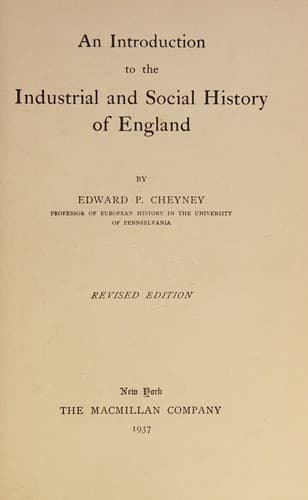
An Introduction to the Industrial and Social History of EnglandCheyney, Edward Potts
History
An Introduction to the Industrial and Social History of England
Cheyney, Edward Potts
Great Britain -- Economic conditions; Great Britain -- Maps; Industries -- Great Britain
recommends in certain cases "well-considered combinations among the
laborers." Therefore public opinion, like the formal law of the
country, has passed from its early opposition to the trade unions,
through criticism and reluctant toleration, to an almost complete
acceptance and even encouragement. Trade unions have become a part of
the regularly established institutions of the country, and few persons
probably would wish to see them go out of existence or be seriously
weakened.
*81. The Growth of Trade Unions.*--The actual growth of trade unionism
has been irregular, interrupted, and has spread from many scattered
centres. Hundreds of unions have been formed, lived for a time, and
gone out of existence; others have survived from the very beginning of
the century to the present; some have dwindled into insignificance and
then revived in some special need. The workmen in some parts of the
country and in certain trades were early and strongly organized, in
others they have scarcely even yet become interested or made the
effort to form unions. In the history of the trade-union movement as a
whole there have been periods of active growth and multiplication and
strengthening of organizations. Again, there have been times when
trade unionism was distinctly losing ground, or when internal
dissension seemed likely to deprive the whole movement of its vigor.
There have been three periods when progress was particularly rapid,
between 1830 and 1834, in 1873 and 1874, and from 1889 to the present
time. But before the middle of the century trade unions existed in
almost every important line of industry. By careful computation it is
estimated that there were in Great Britain and Ireland in 1892 about
1750 distinct unions or separate branches of unions, with some million
and a half members. This would be about twenty per cent of the adult
male working-class population, or an average of about one man who is a
member of a trade union out of five who might be. But the great
importance and influence of the trade unionists arises not from this
comparatively small general proportion, but from the fact that the
organizations are strongest in the most highly skilled and best-paid
industries, and in the most thickly settled, highly developed parts of
the country, and that they contain the picked and ablest men in each
of the industries where they do exist. In some occupations, as cotton
spinning in Lancashire, boiler making and iron ship building in the
seaport towns, coal mining in Northumberland, glass making in the
Midland counties, and others, practically every operative is a member
of a trade union. Similarly in certain parts of the country much more
than half of all workingmen are trade unionists. Their influence also
is far more than in proportion to their numbers, since from their
membership are chosen practically all workingmen representatives in
Parliament and local governments and in administrative positions. The
Public-domain text, read in full here on John Shaqi.
Reviews
Reviews
No reviews yet
Be the first to share your thoughts on this work.
Elsewhere in the archive
Join the Discussion
Join the discussion
Sign in to leave a comment or review.
Sign InorCreate an account