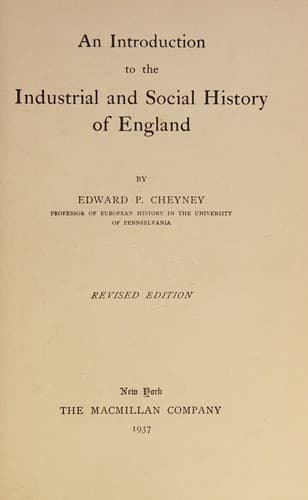
An Introduction to the Industrial and Social History of EnglandCheyney, Edward Potts
History
An Introduction to the Industrial and Social History of England
Cheyney, Edward Potts
Great Britain -- Economic conditions; Great Britain -- Maps; Industries -- Great Britain
From the autumn of 1348 to the spring of 1350 a wave of pestilence
was spreading over England from the southwest northward and eastward,
progressively attacking every part of the country. The disease was new
to Europe. Its course in the individual case, like its progress
through the community, was very rapid. The person attacked either died
within two or three days or even less, or showed signs of recovery
within the same period. The proportion of cases which resulted fatally
was extremely large; the infectious character of the disease quite
remarkable. It was, in fact, an extremely violent epidemic attack, the
most violent in history, of the bubonic plague, with which we have
unfortunately become again familiar within recent years.
From much careful examination of several kinds of contemporary
evidence it seems almost certain that as each locality was
successively attacked in 1348 and 1349 something like a half of the
population died. In other words, whereas in an ordinary year at that
time perhaps one-twentieth of the people died, in the plague year
one-half died. Such entries as the following are frequent in the
contemporary records. At the abbey of Newenham, "in the time of this
mortality or pestilence there died in this house twenty monks and
three lay brothers, whose names are entered in other books. And
Walter, the abbot, and two monks were left alive there after the
sickness." At Leicester, "in the little parish of St. Leonard there
died more than 380, in the parish of Holy Cross more than 400, in that
of St. Margaret more than 700; and so in every parish great numbers."
The close arrangement of houses in the villages, the crowding of
dwellings along narrow streets in the towns, the promiscuous life in
the monasteries and in the inns, the uncleanly habits of living
universally prevalent, all helped to make possible this sweeping away
of perhaps a majority of the population by an attack of epidemic
disease. It had devastated several of the countries of Europe before
appearing in England, having been introduced into Europe apparently
along the great trade routes from the far East. Within a few months
the attack in each successive district subsided, the disease in the
southwestern counties of England having run its course between August,
1348, and May, 1349, in and about London between November, 1348, and
July, 1349, in the eastern counties in the summer of 1349, and in the
more northern counties through the last months of that year or within
the spring of 1350. Pestilence was frequent throughout the Middle
Ages, but this attack was not only vastly more destructive and general
than any which had preceded it, but the disease when once introduced
became a frequent scourge in subsequent times, especially during the
remainder of the fourteenth century. In 1361, 1368, and 1396 attacks
are noticed as occurring more or less widely through the country, but
none were so extensive as that which is usually spoken of as the
Public-domain text, read in full here on John Shaqi.
Reviews
Reviews
No reviews yet
Be the first to share your thoughts on this work.
Elsewhere in the archive
Join the Discussion
Join the discussion
Sign in to leave a comment or review.
Sign InorCreate an account