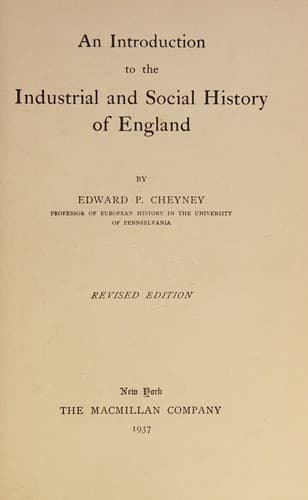
An Introduction to the Industrial and Social History of EnglandCheyney, Edward Potts
History
An Introduction to the Industrial and Social History of England
Cheyney, Edward Potts
Great Britain -- Economic conditions; Great Britain -- Maps; Industries -- Great Britain
The freeholders of land below lords of manors were disadvantageously
affected in as far as they had to hire laborers, but in other ways
were in a more favorable position. The rent which they had to pay was
often reduced. Land was everywhere to be had in plenty, and a threat
to give up their holdings and go to where more favorable terms could
be secured was generally effective in obtaining better terms where
they were.
The villain holders legally of course did not have this opportunity,
but practically they secured many of its advantages. It is probable
that many took up additional land, perhaps on an improved tenure.
Their payments and their labor, whether done in the form of required
"week-work," or, if this were commuted, done for hire, were much
valued, and concessions made to them accordingly. They might, as they
frequently did, take to flight, giving up their land and either
obtaining a new grant somewhere else or becoming laborers without
lands of their own.
This last-named class, made up of those who depended entirely on
agricultural labor on the land of others for their support, was a
class which had been increasing in numbers, and which was the most
distinctly favored by the demand for laborers and the rise of wages.
They were the representatives of the old cotter class, recruited from
those who either inherited no land or found it more advantageous to
work for wages than to take up small holdings with their burdens.
But the most important social result of the Black Death and the period
of pestilence which followed it was the general shock it gave to the
old settled life and established relations of men to one another. It
introduced many immediate changes, and still more causes of ultimate
change; but above all it altered the old stability, so that change in
future would be easy.
*29. The Statutes of Laborers.*--The change which showed itself most
promptly, the rise in the prevailing rate of wages, was met by the
strenuous opposition of the law. In the summer of 1349, while the
pestilence was still raging in the north of England, the king, acting
on the advice of his Council, issued a proclamation to all the
sheriffs and the officials of the larger towns, declaring that the
laborers were taking advantage of the needs of their lords to demand
excessive wages, and prohibiting them from asking more than had been
due and accustomed in the year before the outbreak of the pestilence
or for the preceding five or six years. Every laborer when offered
service at these wages must accept it; the lords of manors having the
first right to the labor of those living on their manors, provided
they did not insist on retaining an unreasonable number. If any
laborers, men or women, bond or free, should refuse to accept such an
offer of work, they were to be imprisoned till they should give bail
to serve as required. Commissioners were then appointed by the king in
each county to inquire into and punish violations of this ordinance.
Public-domain text, read in full here on John Shaqi.
Reviews
Reviews
No reviews yet
Be the first to share your thoughts on this work.
Elsewhere in the archive
Join the Discussion
Join the discussion
Sign in to leave a comment or review.
Sign InorCreate an account