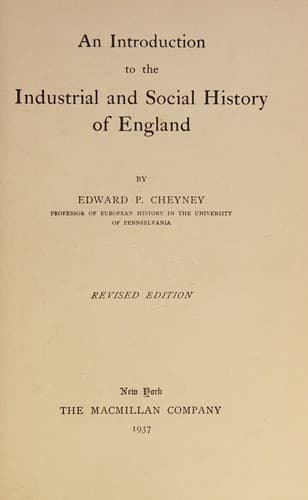
An Introduction to the Industrial and Social History of EnglandCheyney, Edward Potts
History
An Introduction to the Industrial and Social History of England
Cheyney, Edward Potts
Great Britain -- Economic conditions; Great Britain -- Maps; Industries -- Great Britain
Queen Mary, who had been brought up in the Roman faith, tried to make
England again a Roman Catholic country, and in the later years of her
reign encouraged severe persecutions, causing many to be burned at the
stake, in the hope of thus crushing out heresy. After her death,
however, in 1558, Queen Elizabeth adopted a more moderate position,
and the church of England was established by law in much the form it
had possessed at the death of Henry VIII.
In the meantime, however, there had been growing up a far more
spontaneous religious movement than the official Reformation which has
just been described. Many thousands of persons had become deeply
interested in religion and enthusiastic in their faith, and had come
to hold different views on church government, doctrines, and practices
from those approved of either by the Roman Catholic church or by the
government of England. Those who held such views were known as
Puritans, and throughout the reign of Elizabeth were increasing in
numbers and making strenuous though unsuccessful efforts to introduce
changes in the established church.
The reign of Elizabeth was marked not only by the continuance of royal
despotism, by brilliant literary production, and by the struggle of
the established church against the Catholics on the one side and the
Puritans on the other, but by difficult and dangerous foreign
relations.
More than once invasion by the continental powers was imminent.
Elizabeth was threatened with deposition by the English adherents of
Mary, Queen of Scots, supported by France and Spain. The English
government pursued a policy of interference in the internal conflicts
of other countries that brought it frequently to the verge of war with
their governments and sometimes beyond. Hostility bordering on open
warfare was therefore the most frequent condition of English foreign
relations. Especially was this true of the relations with Spain. The
most serious contest with that country was the war which culminated in
the battle of the Armada in 1588. Spain had organized an immense fleet
which was intended to go to the Netherlands and convoy an army to be
taken thence for the invasion of England. While passing through the
English Channel, a storm broke upon them, they were attacked and
harried by the English and later by the Dutch, and the whole fleet was
eventually scattered and destroyed. The danger of invasion was greatly
reduced after this time and until the end of Elizabeth's reign in
1603.
Public-domain text, read in full here on John Shaqi.
Reviews
Reviews
No reviews yet
Be the first to share your thoughts on this work.
Elsewhere in the archive
Join the Discussion
Join the discussion
Sign in to leave a comment or review.
Sign InorCreate an account