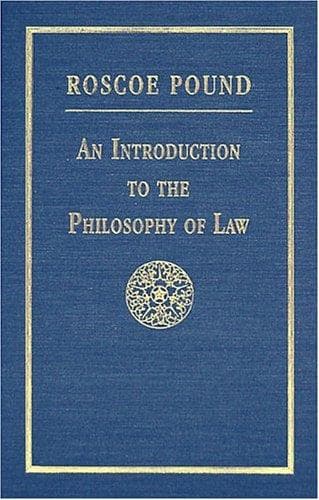
An Introduction to the Philosophy of LawPound, Roscoe
Philosophy
An Introduction to the Philosophy of Law
Pound, Roscoe
Law -- Philosophy
With increasing pressure of the social interest in the security of
transactions through economic development and commercial expansion,
the natural-law philosophy slowly affected this simple scheme of
formal undertakings legally recognized and enforceable and informal
undertakings of only moral efficacy, and brought about the complicated
system of enforceable undertakings in the maturity of Roman law with
which you are familiar. Four features of this movement are noteworthy.
In the first place it led to a juristic theory of formal contract
which has affected our ideas ever since. In the strict law the source
of obligation was in the form itself. For in primitive thinking forms
have an intrinsic efficacy. It has often been pointed out that the
faith in legal forms belongs to the same order of thought as faith in
forms of incantation and that legal forms are frequently symbols to
be classed psychologically with the symbols of magic. The stage of
equity and natural law, relying on reason rather than on form,
governed by philosophy instead of by naïve faith, looked for the
substance and found it in a pact preceding and presupposed by the
formal ceremony. Thus a formal contract was a pact with the addition
of legal form. The pact was the substance of the transaction. The form
was a _causa ciuilis_ or legal reason for enforcing the pact. But if
the form was only a legal reason for enforcing something that got its
natural efficacy in another way, it followed that there might well be
other legal reasons for enforcement besides form. Consequently new
categories of contract were added to the old formal contracts and it
is significant that while the latter were transactions _stricti iuris_
the former were considered transactions _bonae fidei_ involving
liability to what good faith demanded in view of what had been done.
In the scope of their obligation these contracts responded exactly to
the postulate of civilized society that those with whom we deal will
act in good faith and will carry out their undertakings according to
the expectations of the community. On the other hand the old formal
contracts responded thereto in part only since their obligation was
one to do exactly what the terms of the form called for, no more and
no less. When one makes _nexum_, said the Twelve Tables, as he says
orally so be the law. New categories were added in successive strata,
as it were, and juristic science sought afterward to reduce them to
system and logical consistency. Thus real contracts, consensual
contracts and innominate contracts were added. But it is evident that
many of these are juristic rationalizings of what had been done for a
long time through formal transactions. Thus the consensual contract of
sale with its implied warranties rationalizes transfer by _traditio_
with stipulations for the price and for warranties. The real contract
of _depositum_ rationalizes _fiducia cum amico_. The real contract of
_mutuum_ rationalizes _pecunia credita_.
Public-domain text, read in full here on John Shaqi.
Reviews
Reviews
No reviews yet
Be the first to share your thoughts on this work.
Elsewhere in the archive
Join the Discussion
Join the discussion
Sign in to leave a comment or review.
Sign InorCreate an account