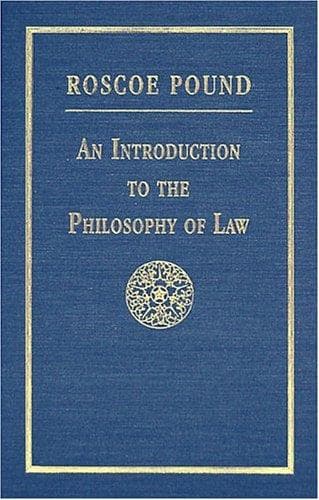
An Introduction to the Philosophy of LawPound, Roscoe
Philosophy
An Introduction to the Philosophy of Law
Pound, Roscoe
Law -- Philosophy
On the Continent the second theory, the theory of the inherent moral
force of a promise made as such, came to prevail. This was the theory
of Grotius. It was generally adopted by Continental writers of the
eighteenth century and, as has been seen, it broke down the Roman
categories and led to the rule that a promise as such, intending a
legal transaction, created legal obligation. At the end of the
eighteenth century Lord Mansfield came very near establishing it in
our law by his doctrine that no promise made as a business transaction
could be _nudum pactum_. But he was too late. Growth stopped for a
season and the nineteenth century set itself to systematize and
harmonize what it had received rather than to carry the development
further.
When the natural-law foundation of enforcing promises crumbled, the
metaphysical jurists sought to provide a new one. Kant said that it
was impossible to prove that one ought to keep his promise, considered
merely as a promise, and deduced contract from property as a form of
conveyance or alienation of one's substance involved in the very idea
of individual rights. So far as consistent with abstract freedom of
will according to a universal law one might alienate his services as
well as his property, and an undertaking to perform something was an
alienation of that sort. This view was generally taken so that while
the seventeenth century sought to rest rights upon contract and the
eighteenth century rested contract on the inherent moral significance
of a promise, the nineteenth century, making the philosophy of
property the important thing, rested contract on property. Three of
these theories are worth a moment's notice.
Public-domain text, read in full here on John Shaqi.
Reviews
Reviews
No reviews yet
Be the first to share your thoughts on this work.
Elsewhere in the archive
Join the Discussion
Join the discussion
Sign in to leave a comment or review.
Sign InorCreate an account