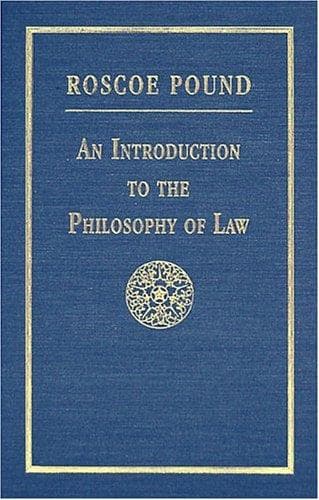
An Introduction to the Philosophy of LawPound, Roscoe
Philosophy
An Introduction to the Philosophy of Law
Pound, Roscoe
Law -- Philosophy
Yet the equivalent theory and the injurious-reliance theory are even
less adequate to explain the actual law. The equivalent theory must
wrestle at the outset with the doctrine that inadequacy of
consideration is immaterial so that the equivalency is often
Pickwickian. Hegel could argue for it on the basis of the Roman
_laesio enormis_. But when a court of equity is willing to uphold a
sale of property worth $20,000 for $200, even a dogmatic fiction is
strained. Moreover the catalogue of anomalies with which the bargain
theory must wrestle contains more than one difficulty for the adherent
of either theory. Stipulations in the course of litigation do not need
equivalents nor do they need to be acted on in order to be
enforceable. A release by mere acknowledgment, when good at all, needs
no equivalent and need not be acted on. Waiver by a surety of the
defense of release by giving time to the principal needs no element of
consideration nor of estoppel. Defectively executed securities,
settlements and advancements need no equivalent and need not be acted
on in order to be reformed. Options under seal are held open in equity
on the basis of the seal alone. A gratuitously declared trust creates
an obligation cognizable in equity without more. In truth the
situation in our law is becoming much the same as that in the
maturity of Roman law and for the same reason. We have three main
categories. First, there are formal contracts, including sealed
instruments, recognizances, and the formal contracts of the law
merchant, in which latter the form consists in the use of certain
words, requirements as to sum certain, payment at all events, and
certainty as to time. Second, there are the real contracts of debt and
bailment. Third, there are simple contracts, without form and upon
consideration. The latter is the growing category although the formal
contracts of the law merchant have shown some power of growth and the
business world has been trying to add thereto letters of credit using
the formal words "confirmed" or "irrevocable." But the category of
enforceable simple promises defies systematic treatment as obstinately
as the actionable pacts in Roman law. Successive additions at
different times in the endeavor of courts to hold men to their
undertakings, in view of the social interest in the security of
transactions and the jural postulates of the civilization of the day,
proceed on all manner of different theories and different analogies
and agree only in the result--that a man's word in the course of
business should be as good as his bond and that his fellow men must be
able to rely on the one equally with the other if our economic order
is to function efficiently. It is evident that many courts consciously
or subconsciously sympathize with Lord Dunedin's feeling that one can
have no liking for a doctrine which enables a promisor to snap his
fingers at a promise deliberately made, fair in itself, and in which
Public-domain text, read in full here on John Shaqi.
Reviews
Reviews
No reviews yet
Be the first to share your thoughts on this work.
Elsewhere in the archive
Join the Discussion
Join the discussion
Sign in to leave a comment or review.
Sign InorCreate an account