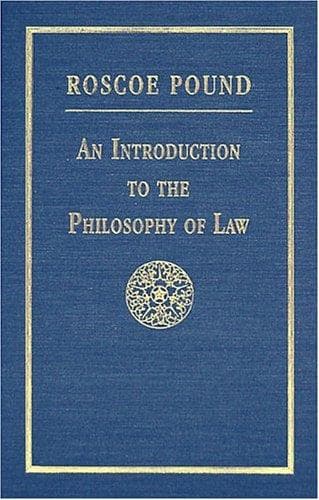
An Introduction to the Philosophy of LawPound, Roscoe
Philosophy
An Introduction to the Philosophy of Law
Pound, Roscoe
Law -- Philosophy
It is usual to describe law as an aggregate of rules. But unless the
word rule is used in so wide a sense as to be misleading, such a
definition, framed with reference to codes or by jurists whose eyes
were fixed upon the law of property, gives an inadequate picture of
the manifold components of a modern legal system. Rules, that is,
definite, detailed provisions for definite, detailed states of fact,
are the main reliance of the beginnings of law. In the maturity of law
they are employed chiefly in situations where there is exceptional
need of certainty in order to uphold the economic order. With the
advent of legal writing and juristic theory in the transition from the
strict law to equity and natural law, a second element develops and
becomes a controlling factor in the administration of justice. In
place of detailed rules precisely determining what shall take place
upon a precisely detailed state of facts, reliance is had upon general
premises for judicial and juristic reasoning. These legal principles,
as we call them, are made use of to supply new rules, to interpret old
ones, to meet new situations, to measure the scope and application of
rules and standards and to reconcile them when they conflict or
overlap. Later, when juristic study seeks to put the materials of the
law in order, a third element develops, which may be called legal
conceptions. These are more or less exactly defined types, to which we
refer cases or by which we classify them, so that when a state of
facts is classified we may attribute thereto the legal consequences
attaching to the type. All of these admit of mechanical or rigidly
logical application. A fourth element, however, which plays a great
part in the everyday administration of justice, is of quite another
character.
Public-domain text, read in full here on John Shaqi.
Reviews
Reviews
No reviews yet
Be the first to share your thoughts on this work.
Elsewhere in the archive
Join the Discussion
Join the discussion
Sign in to leave a comment or review.
Sign InorCreate an account