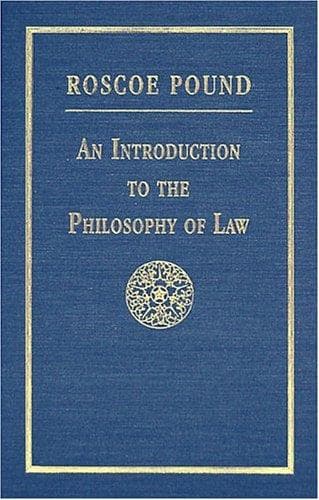
An Introduction to the Philosophy of LawPound, Roscoe
Philosophy
An Introduction to the Philosophy of Law
Pound, Roscoe
Law -- Philosophy
Legal standards of conduct appear first in Roman equity. In certain
cases of transactions or relations involving good faith, the formula
was made to read that the defendant was to be condemned to that which
in good faith he ought to give or do for or render to the plaintiff.
Thus the judge had a margin of discretion to determine what good faith
called for and in Cicero's time the greatest lawyer of the day thought
these _actiones bonae fidei_ required a strong judge because of the
dangerous power which they allowed him. From this procedural device,
Roman lawyers worked out certain standards or measures of conduct,
such as what an upright and diligent head of a family would do, or the
way in which a prudent and diligent husbandman would use his land. In
similar fashion English equity worked out a standard of fair conduct
on the part of a fiduciary. Later the Anglo-American law of torts
worked out, as a measure for those who are pursuing some affirmative
course of conduct, the standard of what a reasonable, prudent man
would do under the circumstances. Also the law of public utilities
worked out standards of reasonable service, reasonable facilities,
reasonable incidents of the service and the like. In all these cases
the rule is that the conduct of one who acts must come up to the
requirements of the standard. Yet the significant thing is not the
fixed rule but the margin of discretion involved in the standard and
its regard for the circumstances of the individual case. For three
characteristics may be seen in legal standards: (1) They all involve a
certain moral judgment upon conduct. It is to be "fair," or
"conscientious," or "reasonable," or "prudent," or "diligent." (2)
They do not call for exact legal knowledge exactly applied, but for
common sense about common things or trained intuition about things
outside of everyone's experience. (3) They are not formulated
absolutely and given an exact content, either by legislation or by
judicial decision, but are relative to times and places and
circumstances and are to be applied with reference to the facts of the
case in hand. They recognize that within the bounds fixed each case is
to a certain extent unique. In the reaction from equity and natural
law, and particularly in the nineteenth century, these standards were
distrusted. Lord Camden's saying that the discretion of a judge was
"the law of tyrants," that it was different in different men, was
"casual" and dependent upon temperament, has in it the whole spirit of
the maturity of law. American state courts sought to turn the
principles by which the chancellors were wont to exercise their
discretion into hard and fast rules of jurisdiction. They sought to
reduce the standard of reasonable care to a set of hard and fast
rules. If one crossed a railroad, he must "stop, look and listen." It
was negligence _per se_ to get on or off a moving car, to have part of
the body protruding from a railroad car, and the like. Also they
Public-domain text, read in full here on John Shaqi.
Reviews
Reviews
No reviews yet
Be the first to share your thoughts on this work.
Elsewhere in the archive
Join the Discussion
Join the discussion
Sign in to leave a comment or review.
Sign InorCreate an account