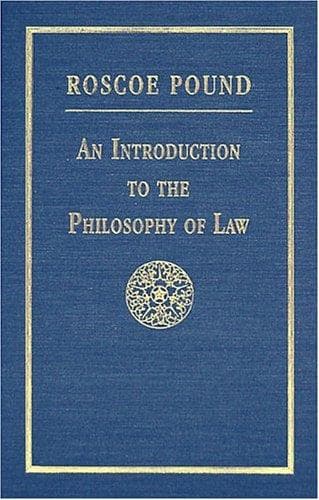
An Introduction to the Philosophy of LawPound, Roscoe
Philosophy
An Introduction to the Philosophy of Law
Pound, Roscoe
Law -- Philosophy
Discretion in the exercise of equitable remedies is an outgrowth of
the purely personal intervention in extraordinary cases on grounds
that appealed to the conscience of the chancellor in which equity
jurisdiction has its origin. Something of the original flavor of
equitable interposition remains in the doctrine of personal bar to
relief, and in the ethical quality of some of the maxims which
announce policies to be pursued in the exercise of the chancellor's
powers. But it was possible for the nineteenth century to reconcile
what remained of the chancellor's discretion with its mode of
thinking. Where the plaintiff's right was legal but the legal remedy
was not adequate to secure him in what the legal right entitled him to
claim, equity gave a concurrent remedy supplementing the strict law.
As the remedy in equity was supplementary and concurrent, in case the
chancellor in his discretion kept his hands off, as he would if he
felt that he could not bring about an equitable result, the law would
still operate. The plaintiff's right was in no wise at the mercy of
anyone's discretion. He merely lost an extraordinary and supplementary
remedy and was left to the ordinary course of the law. Such was the
orthodox view of the relation of law and equity. Equity did not alter
a jot or tittle of the law. It was a remedial system alongside of the
law, taking the law for granted and giving legal rights greater
efficacy in certain situations. But take the case of a "hard bargain,"
where the chancellor in his discretion may deny specific performance.
In England and in several states the damages at law do not include the
value of the bargain where the contract is for the sale of land. Hence
unless specific performance is granted, the plaintiff's legal right is
defeated. It is notorious that bargains appeal differently to
different chancellors in this respect. In the hands of some the
doctrine as to hard bargains has a tendency to become wooden, as it
were. There is a hard and fast rule that certain bargains are "hard"
and that equity will not enforce them. In states where the value of
the bargain may be recovered at law, it may well be sometimes that the
bargain might as well be enforced in equity, if it is not to be
cancelled. But the chancellor is not unlikely to wash his hands of a
hard case, saying that the court of law is more callous; let that
court act, although that court is the same judge with another docket
before him. In other hands, the doctrine tends to become ultro-ethical
and to impair the security of transactions. In other words, the margin
of discretion in application of equitable remedies tends on the one
hand to disappear through crystallization of the principles governing
its exercise into rigid rules, or on the other hand, to become
overpersonal and uncertain and capricious. Yet as one reads the
reports attentively he cannot doubt that in action it is an important
engine of justice; that it is a needed safety valve in the working of
Public-domain text, read in full here on John Shaqi.
Reviews
Reviews
No reviews yet
Be the first to share your thoughts on this work.
Elsewhere in the archive
Join the Discussion
Join the discussion
Sign in to leave a comment or review.
Sign InorCreate an account