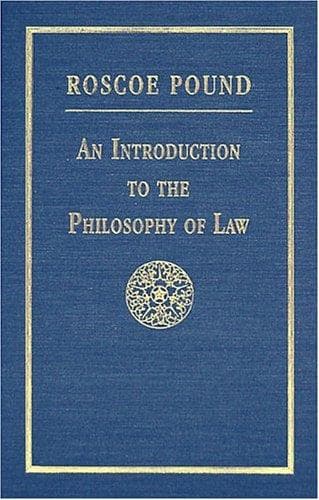
An Introduction to the Philosophy of LawPound, Roscoe
Philosophy
An Introduction to the Philosophy of Law
Pound, Roscoe
Law -- Philosophy
to exclude the administrative element has brought about back-handed
means of individualization which go beyond the needs of the situation
and defeat the purposes of the law.
Even more striking is the recrudescence of personal government, by
way of reaction from an extreme of government of laws and not of men,
which is involved in the setting up of administrative tribunals on
every hand and for every purpose. The regulation of public utilities,
apportionment of the use of the water of running streams among
different appropriators, workmen's compensation, the actual duration
and nature of punishment for crime, admission to and practice of
professions and even of trades, the power to enter or to remain in the
country, banking, insurance, unfair competition and restraint of
trade, the enforcement of factory laws, of pure food laws, of housing
laws and of laws as to protection from fire and the relation of
principal and agent, as between farmers and commission merchants, are
but some of the subjects which the living law, the law in action, is
leaving to executive justice in administrative tribunals. To some
extent this is required by the increasing complexity of the social
order and the minute division of labor which it involves. Yet this
complexity and this division of labor developed for generations in
which the common-law jealousy of administration was dominant. Chiefly
our revival of executive justice in the present century is one of
those reversions to justice without law which are perennial in legal
history. As in the case of like reversions in the past it is the
forerunner of growth. It is the first form of reaction from the
overrigid application of law in a period of stability. A bad
adjustment between law and administration and cumbrous, ineffective
and unbusinesslike legal procedure, involving waste of time and money
in the mere etiquette of justice, are doing in our time what like
conditions did in English law in the middle of the sixteenth century.
Public-domain text, read in full here on John Shaqi.
Reviews
Reviews
No reviews yet
Be the first to share your thoughts on this work.
Elsewhere in the archive
Join the Discussion
Join the discussion
Sign in to leave a comment or review.
Sign InorCreate an account