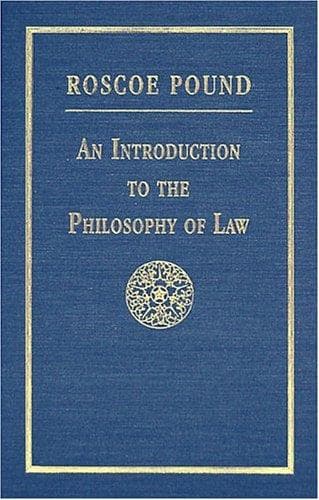
An Introduction to the Philosophy of LawPound, Roscoe
Philosophy
An Introduction to the Philosophy of Law
Pound, Roscoe
Law -- Philosophy
A like conclusion is suggested when we look into the related
controversy as to the respective provinces of common law and of
legislation. Inheritance and succession, definition of interests in
property and the conveyance thereof, matters of commercial law and the
creation, incidents and transfer of obligations have proved a fruitful
field for legislation. In these cases the social interest in the
general security is the controlling element. But where the questions
are not of interests of substance but of the weighing of human conduct
and passing upon its moral aspects, legislation has accomplished
little. No codification of the law of torts has done more than provide
a few significantly broad generalizations. On the other hand,
succession to property is everywhere a matter of statute law and
commercial law is codified or codifying throughout the world. Moreover
the common law insists upon its doctrine of _stare decisis_ chiefly
in the two cases of property and commercial law. Where legislation is
effective, there also mechanical application is effective and
desirable. Where legislation is ineffective, the same difficulties
that prevent its satisfactory operation require us to leave a wide
margin of discretion in application, as in the standard of the
reasonable man in our law of negligence and the standard of the
upright and diligent head of a family applied by the Roman law, and
especially by the modern Roman law, to so many questions of fault,
where the question is really one of good faith. All attempts to cut
down this margin have proved futile. May we not conclude that in the
part of the law which has to do immediately with conduct complete
justice is not to be attained by the mechanical application of fixed
rules? Is it not clear that in this part of the administration of
justice the trained intuition and disciplined judgment of the judge
must be our assurance that causes will be decided on principles of
reason and not according to the chance dictates of caprice, and that
a due balance will be maintained between the general security and the
individual human life?
Public-domain text, read in full here on John Shaqi.
Reviews
Reviews
No reviews yet
Be the first to share your thoughts on this work.
Elsewhere in the archive
Join the Discussion
Join the discussion
Sign in to leave a comment or review.
Sign InorCreate an account