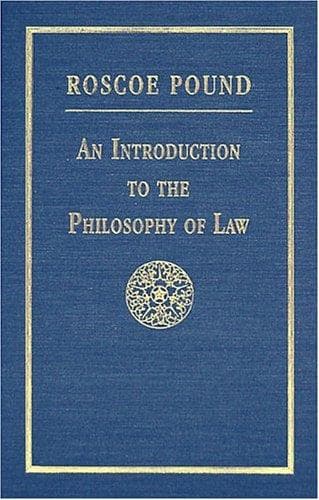
An Introduction to the Philosophy of LawPound, Roscoe
Philosophy
An Introduction to the Philosophy of Law
Pound, Roscoe
Law -- Philosophy
difficulties, there is no reason why we should not generalize, as the
civil law did at the beginning of the last century; and such a
generalization was attempted in the last third of the nineteenth
century. It became orthodox common law that liability was a corollary
of fault. So far as established common-law rules imposed a liability
without fault, they were said to be historical exceptions, and some of
our courts, under the influence of this theory, were willing to go a
long way in abrogating them. Liability, without regard to fault, for
the acts of servants and employees was reconciled with this theory by
the fiction of representation, exposed long ago by Mr. Justice Holmes
and later by Dr. Baty. Finally it came to be thought that no liability
without fault was not merely common law but was natural law and that
any legislative imposition of such liability was arbitrary and
unreasonable in itself and hence unconstitutional. On that theory,
the New York Court of Appeals held workmen's compensation
unconstitutional, and a minority of the Supreme Court of the United
States recently announced the same proposition.
Because of its implications for constitutional law, in view of the
increasing frequency of legislation imposing responsibility at one's
peril in certain enterprises, in the case of certain dangerous
agencies and in situations where it is felt that the loss should be
borne by all of us rather than by the luckless individual who chances
to be hurt, the basis of tort liability has become a question of
moment beyond the immediate law of torts. It is a practical question
of the first importance, as well as a theoretical question of
interest, whether we are to generalize our whole system of tort
liability by means of one principle of liability for fault and for
fault only, as the French sought to do and as we later sought to do
largely under their influence, or, on the other hand, are to admit
another source of delictal liability alongside of fault, as the French
law does in fact and is coming to do in theory, and as our law has
always done in fact. For in our law as it stands one may perceive
readily three types of delictual liability: (1) Liability for
intentional harm, (2) liability for unintentional culpable harm, (3)
liability in certain cases for unintended non-culpable harm. The first
two comport with the doctrine of no liability without fault. The third
cannot be fitted thereto. We must either brand cases of the third type
as historical anomalies, of which we are gradually to rid ourselves,
or else revise our notions of tort liability. Let us remember that the
nineteenth century was well advanced before we understood the subject
of negligence and that before we had convinced ourselves that no
liability without fault was orthodox common law, the highest court of
England had given absolute liability a new field by the decision in
_Rylands_ v. _Fletcher_. We are not questioning a long-established
Public-domain text, read in full here on John Shaqi.
Reviews
Reviews
No reviews yet
Be the first to share your thoughts on this work.
Elsewhere in the archive
Join the Discussion
Join the discussion
Sign in to leave a comment or review.
Sign InorCreate an account