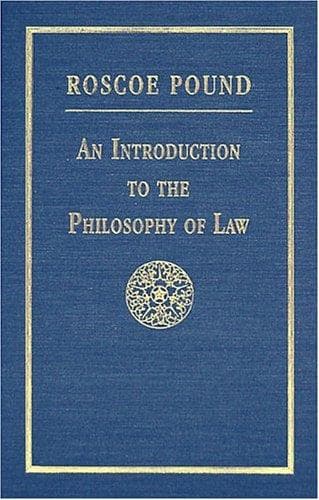
An Introduction to the Philosophy of LawPound, Roscoe
Philosophy
An Introduction to the Philosophy of Law
Pound, Roscoe
Law -- Philosophy
Must we not recognize also a third postulate, namely, that men must
be able to assume that others, who keep things or maintain conditions
or employ agencies that are likely to get out of hand or escape and do
damage, will restrain them or keep them within proper bounds? Just as
we may not go effectively about our several businesses in a society
dependent on a minute division of labor if we must constantly be on
guard against the aggressions or the want of forethought of our
neighbor, so our complex social order based on division of labor may
not function effectively if each of us must stay his activities
through fear of the breaking loose or getting out of hand of something
which his neighbor harbors or maintains. There is danger to the
general security not only in what men do and the way in which they do
it, but also in what they fail to do in not restraining things they
maintain or agencies they employ which may do injury if not kept
strictly in hand. The general security is threatened by wilful
aggression, by affirmative action without due regard for others in the
mode of conducting it, and by harboring and maintaining things and
employing agencies likely to escape or to go out of bounds and do
damage. Looked at in this way, the ultimate basis of delictal
liability is the social interest in the general security. This
interest is threatened or infringed in three ways: (1) Intentional
aggression, (2) negligent action, (3) failure to restrain potentially
dangerous things which one maintains or potentially dangerous agencies
which one employs. Accordingly these three are the immediate bases of
delictal liability.
Public-domain text, read in full here on John Shaqi.
Reviews
Reviews
No reviews yet
Be the first to share your thoughts on this work.
Elsewhere in the archive
Join the Discussion
Join the discussion
Sign in to leave a comment or review.
Sign InorCreate an account