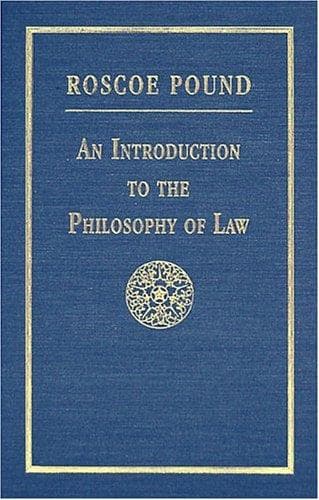
An Introduction to the Philosophy of LawPound, Roscoe
Philosophy
An Introduction to the Philosophy of Law
Pound, Roscoe
Law -- Philosophy
Reconciliation of common-law absolute liabilities for the getting out
of hand of things likely to escape and do damage with the doctrine of
no liability without fault has been sought by means of a fiction of
negligence, by pronouncing them disappearing historical anomalies, by
an economic interpretation that regards them as results of class
interest distorting the law, and by a theory of _res ipsa loquitur_.
Blackstone resorted to the first of these. "A man is answerable,"
he said, "for not only his own trespass but for that of his cattle
also; for if by his negligent keeping they stray upon the land of
another ... this is a trespass for which the owner must answer in
damages." But note that the negligence here is a dogmatic fiction. No
proof of negligence is required of the plaintiff, nor may the
defendant show that there was in fact no negligence. The negligence is
established by the liability, not the liability by the negligence.
In the last century it was usual to refer to absolute liability for
trespassing animals, for injuries by wild animals and for injuries by
domestic animals, known to be vicious, as disappearing rudiments of
the old liability to make composition. The common American doctrine as
to cattle running at large upon uncultivated lands seemed to confirm
this. Yet one need but look beneath the surface to see that the
English rule was rejected for a time in America, not because it was
in conflict with a fundamental principle of no liability without
fault, but because it presupposed a settled community, where it was
contrary to the general security to turn cattle out to graze, whereas
in pioneer American communities of the past vacant lands which were
owned and those which were not owned could not be distinguished and
the grazing resources of the community were often its most important
resources. The common-law rule, without regard to its basis, was for a
time inapplicable to local conditions. It is significant that as the
conditions that made the rule inapplicable have come to an end the
rule has generally re-established itself. In England it is in full
vigor so that the owner of trespassing animals is held for disease
communicated by them although he had no knowledge or reason to suppose
they were diseased. A rule that can re-establish itself and extend its
scope in this way is not moribund. It must have behind it some basis
in the securing of social interests. Nor have the attempts of some
American courts to narrow common-law liability for injuries by known
vicious animals to cases of negligent keeping made much headway. The
weight of American authority remains with the common-law rule and in
England the Court of Appeal has carried the rule out to the extent of
holding the owner notwithstanding the animal was turned loose by the
wrongful act of an intermeddling third person. Nor have the
predictions that the doctrine of _Rylands_ v. _Fletcher_ would
disappear from the law through the courts' smothering it with
Public-domain text, read in full here on John Shaqi.
Reviews
Reviews
No reviews yet
Be the first to share your thoughts on this work.
Elsewhere in the archive
Join the Discussion
Join the discussion
Sign in to leave a comment or review.
Sign InorCreate an account