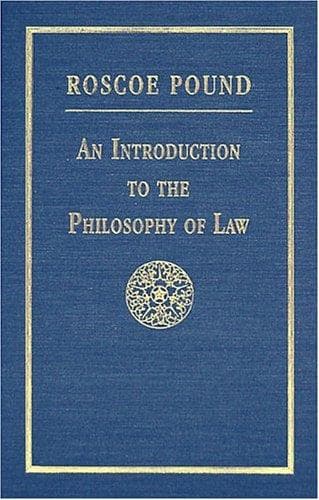
An Introduction to the Philosophy of LawPound, Roscoe
Philosophy
An Introduction to the Philosophy of Law
Pound, Roscoe
Law -- Philosophy
Looking back over the whole subject, shall we not explain more
phenomena and explain them better by saying that the law enforces the
reasonable expectations arising out of conduct, relations and
situations, instead of that it proceeds upon willed action and willed
action only, enforcing the willed consequences of declared intention,
enforcing reparation for willed aggression and enforcing reparation
for culpable carrying on of willed conduct? If we explain more and
explain it more completely by saying that the ultimate thing in the
theory of liability is justifiable reliance under the conditions of
civilized society than by saying that it is free will, we shall have
done all that we may hope to do by any theory.
V
Property
Economic life of the individual in society, as we know it, involves
four claims. One is a claim to the control of certain corporeal
things, the natural media on which human existence depends. Another is
a claim to freedom of industry and contract as an individual asset,
apart from free exercise of one's powers as a phase of personality,
since in a highly organized society the general existence may depend
to a large extent upon individual labor in specialized occupations,
and the power to labor freely at one's chosen occupation may be one's
chief asset. Third, there is a claim to promised advantages, to
promised performances of pecuniary value by others, since in a complex
economic organization with minute division of labor and enterprises
extending over long periods, credit more and more replaces corporeal
wealth as the medium of exchange and agency of commercial activity.
Fourth, there is a claim to be secured against interference by
outsiders with economically advantageous relations with others,
whether contractual, social, business, official or domestic. For not
only do various relations which have an economic value involve claims
against the other party to the relation, which one may demand that the
law secure, but they also involve claims against the world at large
that these advantageous relations, which form an important part of the
substance of the individual, shall not be interfered with. Legal
recognition of these individual claims, legal delimitation and
securing of individual interests of substance is at the foundation of
our economic organization of society. In civilized society men must be
able to assume that they may control, for purposes beneficial to
themselves, what they have discovered and appropriated to their own
use, what they have created by their own labor and what they have
acquired under the existing social and economic order. This is a
jural postulate of civilized society as we know it. The law of
property in the widest sense, including incorporeal property and the
growing doctrines as to protection of economically advantageous
relations, gives effect to the social want or demand formulated in
this postulate. So also does the law of contract in an economic order
based upon credit.
Public-domain text, read in full here on John Shaqi.
Reviews
Reviews
No reviews yet
Be the first to share your thoughts on this work.
Elsewhere in the archive
Join the Discussion
Join the discussion
Sign in to leave a comment or review.
Sign InorCreate an account