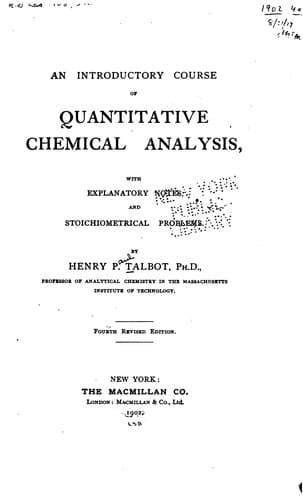
An Introductory Course of Quantitative Chemical Analysis: With Explanatory NotesTalbot, Henry Paul
Science
An Introductory Course of Quantitative Chemical Analysis: With Explanatory Notes
Talbot, Henry Paul
Chemistry, Analytic -- Quantitative
When a direct current of electricity passes from one electrode to
another through solutions of electrolytes, the individual ions present
in these solutions tend to move toward the electrode of opposite
electrical charge to that which each ion bears, and to be discharged
by that electrode. Whether or not such discharge actually occurs in
the case of any particular ion depends upon the potential (voltage) of
the current which is passing through the solution, since for each ion
there is, under definite conditions, a minimum potential below which
the discharge of the ion cannot be effected. By taking advantage
of differences in discharge-potentials, it is possible to effect
separations of a number of the metallic ions by electrolysis, and at
the same time to deposit the metals in forms which admit of direct
weighing. In this way the slower procedures of precipitation and
filtration may frequently be avoided. The following paragraphs present
a brief statement of the fundamental principles and conditions
underlying electro-analysis.
The total energy of an electric current as it passes through a
solution is distributed among three factors, first, its potential,
which is measured in volts, and corresponds to what is called "head"
in a stream of water; second, current strength, which is measured
in amperes, and corresponds to the volume of water passing a
cross-section of a stream in a given time interval; and third, the
resistance of the conducting medium, which is measured in ohms. The
relation between these three factors is expressed by Ohm's law,
namely, that !I = E/R!, when I is current strength, E potential, and R
resistance. It is plain that, for a constant resistance, the
strength of the current and its potential are mutually and directly
interdependent.
As already stated, the applied electrical potential determines whether
or not deposition of a metal upon an electrode actually occurs. The
current strength determines the rate of deposition and the physical
characteristics of the deposit. The resistance of the solution is
generally so small as to fall out of practical consideration.
Approximate deposition-potentials have been determined for a number
of the metallic elements, and also for hydrogen and some of the
acid-forming radicals. The values given below are those required
for deposition from normal solutions at ordinary temperatures
with reference to a hydrogen electrode. They must be regarded as
approximate, since several disturbing factors and some secondary
reactions render difficult their exact application under the
conditions of analysis. They are:
Zn Cd Fe Ni Pb H Cu Sb Hg Ag SO_{4}
+0.77 +0.42 +0.34 +0.33 +0.13 0 -0.34 -0.67 -0.76 -0.79 +1.90
Public-domain text, read in full here on John Shaqi.
Reviews
Reviews
No reviews yet
Be the first to share your thoughts on this work.
Elsewhere in the archive
Join the Discussion
Join the discussion
Sign in to leave a comment or review.
Sign InorCreate an account