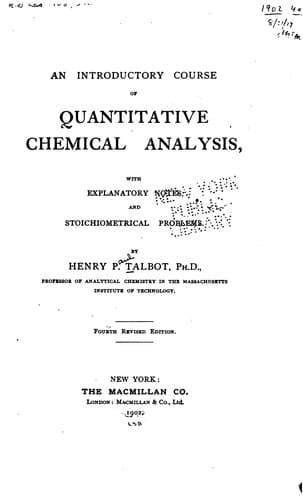
An Introductory Course of Quantitative Chemical Analysis: With Explanatory NotesTalbot, Henry Paul
Science
An Introductory Course of Quantitative Chemical Analysis: With Explanatory Notes
Talbot, Henry Paul
Chemistry, Analytic -- Quantitative
8. In standardizing a hydrochloric acid solution it is found that
47.26 cc. of hydrochloric acid are exactly equivalent to 1.216 grams
of pure sodium carbonate, using methyl orange as an indicator. What is
the normal value of the hydrochloric acid?
!Answer!: 0.4855 N.
9. Convert 42.75 cc. of 0.5162 normal hydrochloric acid to the
equivalent volume of normal hydrochloric acid.
!Answer!: 22.07 cc.
10. A solution containing 25.27 cc. of 0.1065 normal hydrochloric acid
is added to one containing 92.21 cc. of 0.5431 normal sulphuric acid
and 50 cc. of exactly normal potassium hydroxide added from a pipette.
Is the solution acid or alkaline? How many cubic centimeters of
0.1 normal acid or alkali must be added to exactly neutralize the
solution?
!Answer!: 27.6 cc. alkali (solution is acid).
11. By experiment the normal value of a sulphuric acid solution is
found to be 0.5172. Of this acid 39.65 cc. are exactly equivalent to
21.74 cc. of a standard alkali solution. What is the normal value of
the alkali?
!Answer!: 0.9432 N.
12. A solution of sulphuric acid is standardized against a sample of
calcium carbonate which has been previously accurately analyzed and
found to contain 92.44% CaCO_{3} and no other basic material. The
sample weighing 0.7423 gram was titrated by adding an excess of acid
(42.42 cc.) and titrating the excess with sodium hydroxide solution
(11.22 cc.). 1 cc. of acid is equivalent to 0.9976 cc. of sodium
hydroxide. Calculate the normal value of each.
!Answers!: Acid 0.4398 N; alkali 0.4409 N.
13. Given five 10 cc. portions of 0.1 normal hydrochloric acid, (a)
how many grams of silver chloride will be precipitated by a portion
when an excess of silver nitrate is added? (b) how many grams of pure
anhydrous sodium carbonate (Na_{2}CO_{3}) will be neutralized by a
portion of it? (c) how many grams of silver will there be in the
silver chloride formed when an excess of silver nitrate is added to a
portion? (d) how many grams of iron will be dissolved to FeCl_{2} by a
portion of it? (e) how many grams of magnesium chloride will be formed
and how many grams of carbon dioxide liberated when an excess of
magnesium carbonate is treated with a portion of the acid?
!Answers!: (a) 0.1434; (b) 0.053; (c) 0.1079; (d) 0.0279; (e) 0.04765,
and 0.022.
14. If 30.00 grams of potassium tetroxalate
(KHC_{2}O_{4}.H_{2}C_{2}O_{4}.2H_{2}O) are dissolved and the solution
diluted to exactly 1 liter, and 40 cc. are neutralized with 20 cc.
of a potassium carbonate solution, what is the normal value of the
carbonate solution?
!Answer!: 0.7084 N.
15. How many cubic centimeters of 0.3 normal sulphuric acid will be
required to neutralize (a) 30 cc. of 0.5 normal potassium hydroxide;
(b) to neutralize 30 cc. of 0.5 normal barium hydroxide; (c) to
neutralize 20 cc. of a solution containing 10.02 grams of potassium
bicarbonate per 100 cc.; (d) to give a precipitate of barium sulphate
weighing 0.4320 gram?
Public-domain text, read in full here on John Shaqi.
Reviews
Reviews
No reviews yet
Be the first to share your thoughts on this work.
Elsewhere in the archive
Join the Discussion
Join the discussion
Sign in to leave a comment or review.
Sign InorCreate an account