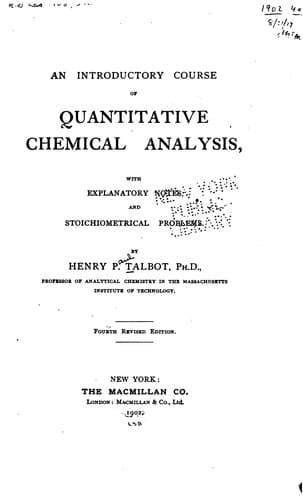
An Introductory Course of Quantitative Chemical Analysis: With Explanatory NotesTalbot, Henry Paul
Science
An Introductory Course of Quantitative Chemical Analysis: With Explanatory Notes
Talbot, Henry Paul
Chemistry, Analytic -- Quantitative
24. A sample of sodium carbonate containing sodium hydroxide weighs
1.179 grams. It is titrated with 0.30 N hydrochloric acid, using
phenolphthalein in cold solution as an indicator and becomes colorless
after the addition of 48.16 cc. Methyl orange is added and 24.08 cc.
are needed for complete neutralization. What is the percentage of NaOH
and Na_{2}CO_{3}?
!Answers!: 24.50% NaOH; 64.92% Na_{2}CO_{3}.
25. From the following data, calculate the percentages of Na_{2}CO_{3}
and NaHCO_{3} in an impure mixture. Weight of sample 1.000 gram;
volume of 0.25 N hydrochloric acid required for phenolphthalein
end-point, 26.40 cc.; after adding an excess of acid and boiling out
the carbon dioxide, the total volume of 0.25 N hydrochloric acid
required for phenolphthalein end-point, 67.10 cc.
!Answer!: 69.95% Na_{2}CO_{3}; 30.02% NaHCO_{3}.
26. In the analysis of a one-gram sample of soda ash, what must be the
normality of the acid in order that the number of cubic centimeters of
acid used shall represent the percentage of carbon dioxide present?
!Answer!: 0.4544 gram.
27. What weight of pearl ash must be taken for analysis in order that
the number of cubic centimeters of 0.5 N acid used may be equal to one
third the percentage of K_{2}CO_{3}?
!Answer!: 1.152 grams.
28. What weight of cream of tartar must have been taken for analysis
in order to have obtained 97.60% KHC_{4}H_{4}O_{6} in an analysis
involving the following data: NaOH used = 30.06 cc.; H_{2}SO_{4}
solution used = 0.50 cc.; 1 cc. H_{2}SO_{4} sol. = 0.0255 gram
CaCO_{3}; 1 cc. H_{2}SO_{4} sol. = 1.02 cc. NaOH sol.?
!Answer!: 2.846 grams.
29. Calculate the percentage of potassium oxide in an impure sample of
potassium carbonate from the following data: Weight of sample = 1.00
gram; HCl sol. used = 55.90 cc.; NaOH sol. used = 0.42 cc.; 1 cc. NaOH
sol. = 0.008473 gram of KHC_{2}O_{4}.H_{2}C_{2}O_{4}.2H_{2}O; 2 cc.
HCl sol. = 5 cc. NaOH sol.
!Answer!: 65.68%.
30. Calculate the percentage purity of a sample of calcite
(CaCO_{3}) from the following data: (Standardization); Weight of
H_{2}C_{2}O_{4}.2H_{2}O = 0.2460 gram; NaOH solution used = 41.03
cc.; HCl solution used = 0.63; 1 cc. NaOH solution = 1.190 cc. HCl
solution. (Analysis); Weight of sample 0.1200 gram; HCl used = 36.38
cc.; NaOH used = 6.20 cc.
!Answer!: 97.97%.
31. It is desired to dilute a solution of hydrochloric acid to exactly
0.05 N. The following data are given: 44.97 cc. of the hydrochloric
acid are equivalent to 43.76 cc. of the NaOH solution. The NaOH
is standardized against a pure potassium tetroxalate
(KHC_{2}O_{4}.H_{2}C_{2}O_{4}.2H_{2}O) weighing 0.2162 gram and
requires 49.14 cc. How many cc. of water must be added to 1000 cc. of
the aqueous hydrochloric acid?
!Answer!: 11 cc.
32. How many cubic centimeters of 3 N phosphoric acid must be added to
300 cc. of 0.4 N phosphoric acid in order that the resulting solution
may be 0.6 N?
!Answer!: 25 cc.
Public-domain text, read in full here on John Shaqi.
Reviews
Reviews
No reviews yet
Be the first to share your thoughts on this work.
Elsewhere in the archive
Join the Discussion
Join the discussion
Sign in to leave a comment or review.
Sign InorCreate an account