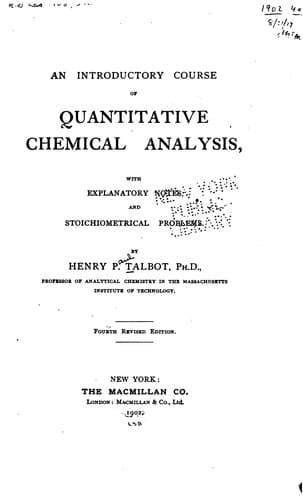
An Introductory Course of Quantitative Chemical Analysis: With Explanatory NotesTalbot, Henry Paul
Science
An Introductory Course of Quantitative Chemical Analysis: With Explanatory Notes
Talbot, Henry Paul
Chemistry, Analytic -- Quantitative
44. One gram of an oxide of iron is fused with potassium acid sulphate
and the fusion dissolved in acid. The iron is reduced with stannous
chloride, mercuric chloride is added, and the iron titrated with a
normal K_{2}Cr_{2}O_{7} solution. 12.94 cc. were used. What is the
formula of the oxide, FeO, Fe_{2}O_{3}, or Fe_{3}O_{4}?
!Answer!: Fe_{3}O_{4}.
45. If an element has 98 for its atomic weight, and after reduction
with stannous chloride could be oxidized by bichromate to a state
corresponding to an XO_{4}^{-} anion, compute the oxide, or valence,
corresponding to the reduced state from the following data: 0.3266
gram of the pure element, after being dissolved, was reduced with
stannous chloride and oxidized by 40 cc. of K_{2}Cr_{2}O_{7}, of which
one cc. = 0.1960 gram of FeSO_{4}(NH_{4})_{2}SO_{4}.6H_{2}O.
!Answer!: Monovalent.
46. Determine the percentage of iron in a sample of limonite from the
following data: Sample = 0.5000 gram. KMnO_{4} used = 50 cc. 1 cc.
KMnO_{4} = 0.005317 gram Fe. FeSO_{4} used = 6 cc. 1 cc. FeSO_{4} =
0.009200 gram FeO.
!Answer!: 44.60%.
47. If 1 gram of a silicate yields 0.5000 gram of Fe_{2}O_{3} and
Al_{2}O_{3} and the iron present requires 25 cc. of 0.2 N KMnO_{4},
calculate the percentage of FeO and Al_{2}O_{3} in the sample.
!Answer!: 35.89% FeO; 10.03% Al_{2}O_{3}.
48. A sample of magnesia limestone has the following composition:
Silica, 3.00%; ferric oxide and alumina, 0.20%; calcium oxide, 33.10%;
magnesium oxide, 20.70%; carbon dioxide, 43.00%. In manufacturing lime
from the above the carbon dioxide is reduced to 3.00%. How many cubic
centimeters of normal KMnO_{4} will be required to determine the
calcium oxide volumetrically in a 1 gram sample of the lime?
!Answer!: 20.08 cc.
49. If 100 cc. of potassium bichromate solution (10 gram
K_{2}Cr_{2}O_{7} per liter), 5 cc. of 6 N sulphuric acid, and 75 cc.
of ferrous sulphate solution (80 grams FeSO_{4}.7H_{2}O per liter) are
mixed, and the resulting solution titrated with 0.2121 N KMnO_{4}, how
many cubic centimeters of the KMnO_{4} solution will be required to
oxidize the iron?
!Answer!: 5.70 cc.
50. If a 0.5000 gram sample of limonite containing 59.50 per cent
Fe_{2}O_{3} requires 40 cc. of KMnO_{4} to oxidize the iron, what
is the value of 1 cc. of the permanganate in terms of (a) Fe, (b)
H_{2}C_{2}O_{4}.2H_{2}O?
!Answers!: (a) 0.005189 gram; (b) 0.005859 gram.
51. A sample of pyrolusite weighing 0.6000 gram is treated with 0.9000
gram of oxalic acid. The excess oxalic acid requires 23.95 cc. of
permanganate (1 cc. = 0.03038 gram FeSO_{4}.7H_{2}O). What is the
percentage of MnO_{2}, in the sample?
!Answer!: 84.47%.
52. A solution contains 50 grams of
KHC_{2}O_{4}.H_{2}C_{2}O_{4}.2H_{2}O per liter. What is the normal
value of the solution (a) as an acid, and (b) as a reducing agent?
!Answers!: (a) 0.5903 N; (b) 0.7872 N.
Public-domain text, read in full here on John Shaqi.
Reviews
Reviews
No reviews yet
Be the first to share your thoughts on this work.
Elsewhere in the archive
Join the Discussion
Join the discussion
Sign in to leave a comment or review.
Sign InorCreate an account