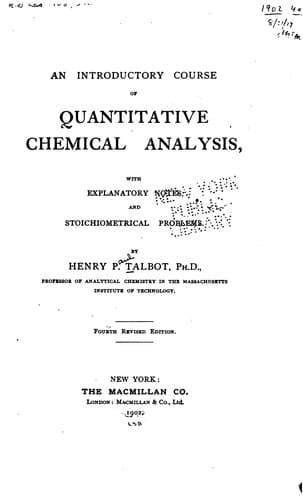
An Introductory Course of Quantitative Chemical Analysis: With Explanatory NotesTalbot, Henry Paul
Science
An Introductory Course of Quantitative Chemical Analysis: With Explanatory Notes
Talbot, Henry Paul
Chemistry, Analytic -- Quantitative
Ionic reactions are all, to a greater or less degree, !reversible
reactions!. A typical example of an easily reversible reaction is that
representing the changes in ionization which an electrolyte such as
acetic acid undergoes on dilution or concentration of its solutions,
!i.e.!, HC_{2}H_{3}O_{2} <--> H^{+} + C_{2}H_{3}O_{2}^{-}. As was
stated above, the ionization increases with dilution, the reaction
then proceeding from left to right, while concentration of the
solution occasions a partial reassociation of the ions, and the
reaction proceeds from right to left. To understand the principle
underlying these changes it is necessary to consider first the
conditions which prevail when a solution of acetic acid, which has
been stirred until it is of uniform concentration throughout, has come
to a constant temperature. A careful study of such solutions has shown
that there is a definite state of equilibrium between the constituents
of the solution; that is, there is a definite relation between the
undissociated acetic acid and its ions, which is characteristic for
the prevailing conditions. It is not, however, assumed that this is a
condition of static equilibrium, but rather that there is continual
dissociation and association, as represented by the opposing
reactions, the apparent condition of rest resulting from the fact that
the amount of change in one direction during a given time is exactly
equal to that in the opposite direction. A quantitative study of
the amount of undissociated acid, and of H^{+} ions and
C_{2}H_{3}O_{2}^{-} ions actually to be found in a large number of
solutions of acetic acid of varying dilution (assuming them to be in
a condition of equilibrium at a common temperature), has shown that
there is always a definite relation between these three quantities
which may be expressed thus:
(!Conc'n H^{+} x Conc'n C_{2}H_{3}O_{2}^{-})/Conc'n HC_{2}H_{3}O_{2} =
Constant!.
In other words, there is always a definite and constant ratio between
the product of the concentrations of the ions and the concentration of
the undissociated acid when conditions of equilibrium prevail.
It has been found, further, that a similar statement may be made
regarding all reversible reactions, which may be expressed in general
terms thus: The rate of chemical change is proportional to the product
of the concentrations of the substances taking part in the reaction;
or, if conditions of equilibrium are considered in which, as stated,
the rate of change in opposite directions is assumed to be equal, then
the product of the concentrations of the substances entering into
the reaction stands in a constant ratio to the product of the
concentrations of the resulting substances, as given in the expression
above for the solutions of acetic acid. This principle is called the
!Law of Mass Action!.
Public-domain text, read in full here on John Shaqi.
Reviews
Reviews
No reviews yet
Be the first to share your thoughts on this work.
Elsewhere in the archive
Join the Discussion
Join the discussion
Sign in to leave a comment or review.
Sign InorCreate an account