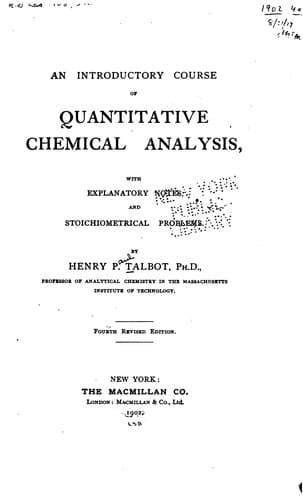
An Introductory Course of Quantitative Chemical Analysis: With Explanatory NotesTalbot, Henry Paul
Science
An Introductory Course of Quantitative Chemical Analysis: With Explanatory Notes
Talbot, Henry Paul
Chemistry, Analytic -- Quantitative
Pour the iron solution while hot (but not boiling) through the
reductor at a rate not exceeding 50 cc. per minute (Notes 2 and 3).
Wash out the beaker with dilute sulphuric acid, and follow the iron
solution without interruption with 175 cc. of the warm acid and
finally with 75 cc. of distilled water, leaving the funnel partially
filled. Remove the filter bottle and cool the solution quickly under
the water tap (Note 4), avoiding unnecessary exposure to the oxygen of
the air. Add 10 cc. of dilute sulphuric acid and titrate to a faint
pink with the permanganate solution, adding it directly to the
contents of the vacuum flask. Should the end-point be overstepped, the
ferrous sulphate solution may be added.
From the volume of the solution required to oxidize the iron in
the wire, calculate the relation to the normal of the permanganate
solution. The duplicate results should be concordant within two parts
in one thousand.
[Note 1: The funnel of the reductor must never be allowed to empty.
If it is left partially filled with water the reductor is ready for
subsequent use after a very little washing; but a preliminary test is
always necessary to safeguard against error.
If more than a small drop of permanganate solution is required to
color 100 cc. of the dilute acid after the reductor is well washed, an
allowance must be made for the iron in the zinc. !Great care! must be
used to prevent the access of air to the reductor after it has been
washed out ready for use. If air enters, hydrogen peroxide forms,
which reacts with the permanganate, and the results are worthless.]
[Note 2: The iron is reduced to the ferrous condition by contact with
the zinc. The active agent may be considered to be !nascent! hydrogen,
and it must be borne in mind that the visible bubbles are produced by
molecular hydrogen, which is without appreciable effect upon ferric
iron.
The rate at which the iron solution passes through the zinc should not
exceed that prescribed, but the rate may be increased somewhat when
the wash-water is added. It is well to allow the iron solution to run
nearly, but not entirely, out of the funnel before the wash-water
is added. If it is necessary to interrupt the process, the complete
emptying of the funnel can always be avoided by closing the stopcock.
It is also possible to reduce the iron by treatment with zinc in a
flask from which air is excluded. The zinc must be present in excess
of the quantity necessary to reduce the iron and is finally completely
dissolved. This method is, however, less convenient and more tedious
than the use of the reductor.]
[Note 3: The dilute sulphuric acid for washing must be warmed ready
for use before the reduction of the iron begins, and it is of the
first importance that the volume of acid and of wash-water should
be measured, and the volume used should always be the same in the
standardizations and all subsequent analyses.]
Public-domain text, read in full here on John Shaqi.
Reviews
Reviews
No reviews yet
Be the first to share your thoughts on this work.
Join the Discussion
Join the discussion
Sign in to leave a comment or review.
Sign InorCreate an account