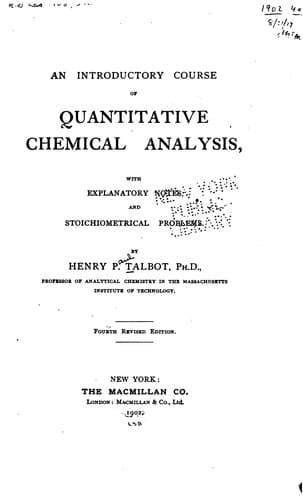
An Introductory Course of Quantitative Chemical Analysis: With Explanatory NotesTalbot, Henry Paul
Science
An Introductory Course of Quantitative Chemical Analysis: With Explanatory Notes
Talbot, Henry Paul
Chemistry, Analytic -- Quantitative
[Note 4: The end-point is more permanent in cold than hot solutions,
possibly because of a slight action of the permanganate upon the
manganous sulphate formed during titration. If the solution turns
brown, it is an evidence of insufficient acid, and more should be
immediately added. The results are likely to be less accurate in this
case, however, as a consequence of secondary reactions between the
ferrous iron and the manganese dioxide thrown down. It is wiser to
discard such results and repeat the process.]
[Note 5: The potassium permanganate may, of course, be diluted and
brought to an exactly 0.1 N solution from the data here obtained. The
percentage of iron in the iron wire must be taken into account in all
calculations.]
!Method B!
!Oxalate Standards!
PROCEDURE.--Weigh out two portions of pure sodium oxalate of 0.25-0.3
gram each into beakers of about 600 cc. capacity. Add about 400 cc. of
boiling water and 20 cc. of manganous sulphate solution (Note 1).
When the solution of the oxalate is complete, heat the liquid, if
necessary, until near its boiling point (70-90°C.) and run in the
standard permanganate solution drop by drop from a burette, stirring
constantly until an end-point is reached (Note 2). Make a blank test
with 20 cc. of manganous sulphate solution and a volume of distilled
water equal to that of the titrated solution to determine the volume
of the permanganate solution required to produce a very slight pink.
Deduct this volume from the amount of permanganate solution used in
the titration.
From the data obtained, calculate the relation of the permanganate
solution to the normal. The reaction involved is:
5Na_{2}C_{2}O_{4} + 2KMnO_{4} + 8H_{2}SO_{4} --> 5Na_{2}SO_{4} +
K_{2}SO_{4} + 2MnSO_{4} + 10CO_{2} + 8H_{2}O
[Note 1: The manganous sulphate titrating solution is made by
dissolving 20 grams of MnSO_{4} in 200 cubic centimeters of water and
adding 40 cc. of concentrated sulphuric acid (sp. gr. 1.84) and 40 cc.
or phosphoric acid (85%).]
[Note 2: The reaction between oxalates and permanganates takes place
quantitatively only in hot acid solutions. The temperatures must not
fall below 70°C.]
DETERMINATION OF IRON IN LIMONITE
!Method A!
The procedures, as here prescribed, are applicable to iron ores in
general, provided these ores contain no constituents which are reduced
by zinc or stannous chloride and reoxidized by permanganates. Many
iron ores contain titanium, and this element among others does
interfere with the determination of iron by the process described.
If, however, the solutions of such ores are treated with sulphureted
hydrogen or sulphurous acid, instead of zinc or stannous chloride to
reduce the iron, and the excess reducing agent removed by boiling, an
accurate determination of the iron can be made.
Public-domain text, read in full here on John Shaqi.
Reviews
Reviews
No reviews yet
Be the first to share your thoughts on this work.
Elsewhere in the archive
Join the Discussion
Join the discussion
Sign in to leave a comment or review.
Sign InorCreate an account