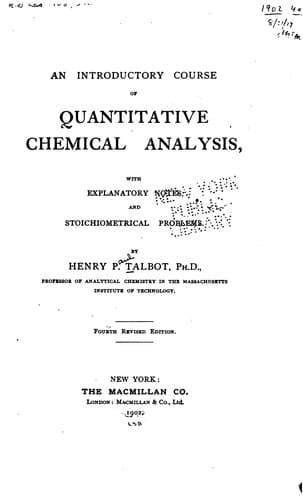
An Introductory Course of Quantitative Chemical Analysis: With Explanatory NotesTalbot, Henry Paul
Science
An Introductory Course of Quantitative Chemical Analysis: With Explanatory Notes
Talbot, Henry Paul
Chemistry, Analytic -- Quantitative
From the standardization data already obtained calculate the
percentage of iron (Fe) in the limonite.
[Note 1: It has already been noted that hydrochloric acid reacts
slowly in cold solutions with potassium permanganate. It is, however,
possible to obtain a satisfactory, although somewhat fugitive
end-point in the presence of manganous sulphate and phosphoric acid.
The explanation of the part played by these reagents is somewhat
obscure as yet. It is possible that an intermediate manganic compound
is formed which reacts rapidly with the ferrous compounds--thus in
effect catalyzing the oxidizing process.
While an excess of hydrochloric acid is necessary for the successful
reduction of the iron by stannous chloride, too large an amount
should be avoided in order to lessen the chance of reduction of the
permanganate by the acid during titration.]
DETERMINATION OF THE OXIDIZING POWER OF PYROLUSITE
INDIRECT OXIDATION
Pyrolusite, when pure, consists of manganese dioxide. Its value as an
oxidizing agent, and for the production of chlorine, depends upon the
percentage of MnO_{2} in the sample. This percentage is determined
by an indirect method, in which the manganese dioxide is reduced and
dissolved by an excess of ferrous sulphate or oxalic acid in the
presence of sulphuric acid, and the unused excess determined by
titration with standard permanganate solution.
PROCEDURE.--Grind the mineral in an agate mortar until no grit
whatever can be detected under the pestle (Note 1). Transfer it to a
stoppered weighing-tube, and weigh out two portions of about 0.5 gram
into beakers (400-500 cc.) Read Note 2, and then calculate in each
case the weight of oxalic acid (H_{2}C_{2}O_{4}.2H_{2}O) required to
react with the weights of pyrolusite taken. The reaction involved is
MnO_{2} + H_{2}C_{2}O_{4}(2H_{2}O) + H_{2}SO_{4} --> MnSO_{4} +
2CO_{2} + 4H_{2}O.
Weigh out about 0.2 gram in excess of this quantity of !pure! oxalic
acid into the corresponding beakers, weighing the acid accurately and
recording the weight in the notebook. Pour into each beaker 25 cc. of
water and 50 cc. of dilute sulphuric acid (1:5), cover and warm the
beaker and its contents gently until the evolution of carbon dioxide
ceases (Note 3). If a residue remains which is sufficiently colored to
obscure the end-reaction of the permanganate, it must be removed by
filtration.
Finally, dilute the solution to 200-300 cc., heat the solution to a
temperature just below boiling, add 15 cc. of a manganese sulphate
solution and while hot, titrate for the excess of the oxalic acid with
standard permanganate solution (Notes 4 and 5).
From the corrected volume of the solution required, calculate the
amount of oxalic acid undecomposed by the pyrolusite; subtract this
from the total quantity of acid used, and calculate the weight of
manganese dioxide which would react with the balance of the acid, and
from this the percentage in the sample.
Public-domain text, read in full here on John Shaqi.
Reviews
Reviews
No reviews yet
Be the first to share your thoughts on this work.
Elsewhere in the archive
Join the Discussion
Join the discussion
Sign in to leave a comment or review.
Sign InorCreate an account