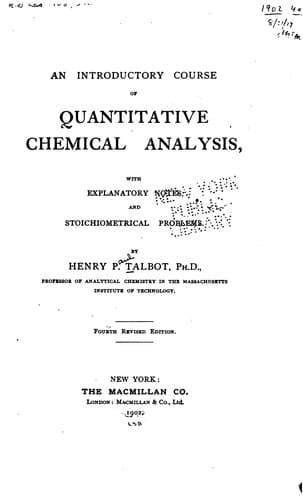
An Introductory Course of Quantitative Chemical Analysis: With Explanatory NotesTalbot, Henry Paul
Science
An Introductory Course of Quantitative Chemical Analysis: With Explanatory Notes
Talbot, Henry Paul
Chemistry, Analytic -- Quantitative
PROCEDURE.--Grind the mineral to a fine powder. Weigh out two portions
of about 0.5 gram each into small porcelain crucibles. Roast the ore
at dull redness for ten minutes (Note 1), allow the crucibles to cool,
and place them and their contents in casseroles containing 30 cc. of
dilute hydrochloric acid (sp. gr. 1.12).
Proceed with the solution of the ore, and the treatment of the
residue, if necessary, exactly as described for the bichromate process
on page 56. When solution is complete, add 6 cc. of concentrated
sulphuric acid to each casserole, and evaporate on the steam bath
until the solution is nearly colorless (Note 2). Cover the casseroles
and heat over the flame of the burner, holding the casserole in
the hand and rotating it slowly to hasten evaporation and prevent
spattering, until the heavy white fumes of sulphuric anhydride are
freely evolved (Note 3). Cool the casseroles, add 100 cc. of water
(measured), and boil gently until the ferric sulphate is dissolved;
pour the warm solution through the reductor which has been previously
washed; proceed as described under standardization, taking pains
to use the same volume and strength of acid and the same volume of
wash-water as there prescribed, and titrate with the permanganate
solution in the reductor flask, using the ferrous sulphate solution if
the end-point should be overstepped.
From the corrected volume of permanganate solution used, calculate the
percentage of iron (Fe) in the limonite.
[Note 1: The preliminary roasting is usually necessary because, even
though the sulphuric acid would subsequently char the carbonaceous
matter, certain nitrogenous bodies are not thereby rendered insoluble
in the acid, and would be oxidized by the permanganate.]
[Note 2: The temperature of the steam bath is not sufficient to
volatilize sulphuric acid. Solutions may, therefore, be left to
evaporate overnight without danger of evaporation to dryness.]
[Note 3: The hydrochloric acid, both free and combined, is displaced
by the less volatile sulphuric acid at its boiling point. Ferric
sulphate separates at this point, since there is no water to hold
it in solution and care is required to prevent bumping. The ferric
sulphate usually has a silky appearance and is easily distinguished
from the flocculent silica which often remains undissolved.]
!Zimmermann-Reinhardt Procedure!
!Method (B)!
PROCEDURE.--Grind the mineral to a fine powder. Weigh out two portions
of about 0.5 gram each into small porcelain crucibles. Proceed with
the solution of the ore, treat the residue, if necessary, and reduce
the iron by the addition of stannous chloride, followed by mercuric
chloride, as described for the bichromate process on page 56. Dilute
the solution to about 400 cc. with cold water, add 10 cc. of the
manganous sulphate titrating solution (Note 1, page 68) and titrate
with the standard potassium permanganate solution to a faint pink
(Note 1).
Public-domain text, read in full here on John Shaqi.
Reviews
Reviews
No reviews yet
Be the first to share your thoughts on this work.
Elsewhere in the archive
Join the Discussion
Join the discussion
Sign in to leave a comment or review.
Sign InorCreate an account