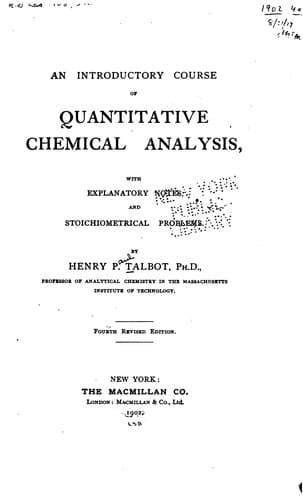
An Introductory Course of Quantitative Chemical Analysis: With Explanatory NotesTalbot, Henry Paul
Science
An Introductory Course of Quantitative Chemical Analysis: With Explanatory Notes
Talbot, Henry Paul
Chemistry, Analytic -- Quantitative
The titration of iodine against sodium thiosulphate, with starch as an
indicator, may perhaps be regarded as the most accurate of volumetric
processes. The thiosulphate solution may be used in both acid and
neutral solutions to measure free iodine and the latter may, in turn,
serve as a measure of any substance capable of liberating iodine from
potassium iodide under suitable conditions for titration, as, for
example, in the process outlined in Note 5 on page 74.
The fundamental reaction upon which iodometric processes are based is
the following:
I_{2} + 2 Na_{2}S_{2}O_{3} --> 2 NaI + Na_{2}S_{4}O_{6}.
This reaction between iodine and sodium thiosulphate, resulting in
the formation of the compound Na_{2}S_{4}O_{6}, called sodium
tetrathionate, is quantitatively exact, and differs in that
respect from the action of chlorine or bromine, which oxidize the
thiosulphate, but not quantitatively.
NORMAL SOLUTIONS OF IODINE AND SODIUM THIOSULPHATE
If the formulas of sodium thiosulphate and sodium tetrathionate are
written in a manner to show the atoms of oxygen associated
with sulphur atoms in each, thus, 2(Na_{2}).S_{2}O_{2} and
Na_{2}O.S_{4}O_{5}, it is plain that in the tetrathionate there are
five atoms of oxygen associated with sulphur, instead of the four
in the two molecules of the thiosulphate taken together. Although,
therefore, the iodine contains no oxygen, the two atoms of iodine
have, in effect, brought about the addition of one oxygen atoms to the
sulphur atoms. That is the same thing as saying that 253.84 grams of
iodine (I_{2}) are equivalent to 16 grams of oxygen; hence, since 8
grams of oxygen is the basis of normal solutions, 253.84/2 or 126.97
grams of iodine should be contained in one liter of normal iodine
solution. By a similar course of reasoning the conclusion is reached
that the normal solution of sodium thiosulphate should contain,
per liter, its molecular weight in grams. As the thiosulphate in
crystalline form has the formula Na_{2}S_{2}O_{3}.5H_{2}O, this weight
is 248.12 grams. Tenth-normal or hundredth-normal solutions are
generally used.
PREPARATION OF STANDARD SOLUTIONS
!Approximate Strength, 0.1 N!
PROCEDURE.--Weigh out on the rough balances 13 grams of commercial
iodine. Place it in a mortar with 18 grams of potassium iodide and
triturate with small portions of water until all is dissolved. Dilute
the solution to 1000 cc. and transfer to a liter bottle and mix
thoroughly (Note 1).[1]
[Footnote 1: It will be found more economical to have a considerable
quantity of the solution prepared by a laboratory attendant, and to
have all unused solutions returned to the common stock.]
Weigh out 25 grams of sodium thiosulphate, dissolve it in water which
has been previously boiled and cooled, and dilute to 1000 cc., also
with boiled water. Transfer the solution to a liter bottle and mix
thoroughly (Note 2).
Public-domain text, read in full here on John Shaqi.
Reviews
Reviews
No reviews yet
Be the first to share your thoughts on this work.
Elsewhere in the archive
Join the Discussion
Join the discussion
Sign in to leave a comment or review.
Sign InorCreate an account