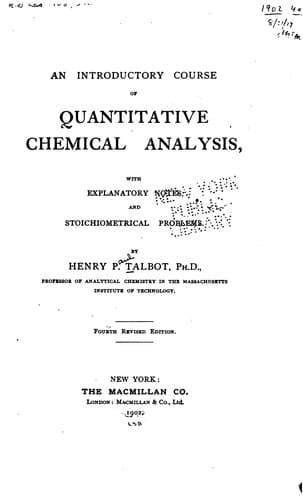
An Introductory Course of Quantitative Chemical Analysis: With Explanatory NotesTalbot, Henry Paul
Science
An Introductory Course of Quantitative Chemical Analysis: With Explanatory Notes
Talbot, Henry Paul
Chemistry, Analytic -- Quantitative
[Note 1: Iodine solutions react with water to form hydriodic acid
under the influence of the sunlight, and even at low room temperatures
the iodine tends to volatilize from solution. They should, therefore,
be protected from light and heat. Iodine solutions are not stable for
long periods under the best of conditions. They cannot be used in
burettes with rubber tips, since they attack the rubber.]
[Note 2: Sodium thiosulphate (Na_{2}S_{2}O_{3}.5H_{2}O) is
rarely wholly pure as sold commercially, but may be purified by
recrystallization. The carbon dioxide absorbed from the air by
distilled water decomposes the salt, with the separation of sulphur.
Boiled water which has been cooled out of contact with the air should
be used in preparing solutions.]
INDICATOR SOLUTION
The starch solution for use as an indicator must be freshly prepared.
A soluble starch is obtainable which serves well, and a solution of
0.5 gram of this starch in 25 cc. of boiling water is sufficient. The
solution should be filtered while hot and is ready for use when cold.
If soluble starch is not at hand, potato starch may be used. Mix about
1 gram with 5 cc. of cold water to a smooth paste, pour 150 cc. of
!boiling! water over it, warm for a moment on the hot plate, and put
it aside to settle. Decant the supernatant liquid through a filter
and use the clear filtrate; 5 cc. of this solution are needed for a
titration.
The solution of potato starch is less stable than the soluble starch.
The solid particles of the starch, if not removed by filtration,
become so colored by the iodine that they are not readily decolorized
by the thiosulphate (Note 1).
[Note 1: The blue color which results when free iodine and starch
are brought together is probably not due to the formation of a true
chemical compound. It is regarded as a "solid solution" of iodine in
starch. Although it is unstable, and easily destroyed by heat, it
serves as an indicator for the presence of free iodine of remarkable
sensitiveness, and makes the iodometric processes the most
satisfactory of any in the field of volumetric analysis.]
COMPARISON OF IODINE AND THIOSULPHATE SOLUTIONS
PROCEDURE.--Place the solutions in burettes (the iodine in a
glass-stoppered burette), observing the usual precautions. Run out 40
cc. of the thiosulphate solution into a beaker, dilute with 150 cc. of
water, add 1 cc. to 2 cc. of the soluble starch solution, and titrate
with the iodine to the appearance of the blue of the iodo-starch.
Repeat until the ratio of the two solutions is established,
remembering all necessary corrections for burettes and for temperature
changes.
STANDARDIZATION OF SOLUTIONS
Public-domain text, read in full here on John Shaqi.
Reviews
Reviews
No reviews yet
Be the first to share your thoughts on this work.
Elsewhere in the archive
Join the Discussion
Join the discussion
Sign in to leave a comment or review.
Sign InorCreate an account