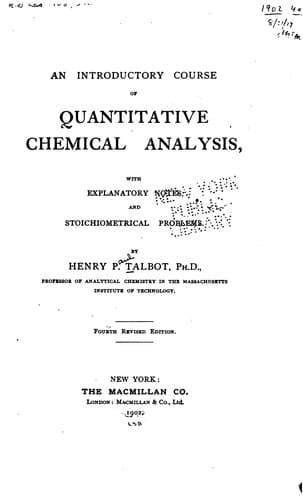
An Introductory Course of Quantitative Chemical Analysis: With Explanatory NotesTalbot, Henry Paul
Science
An Introductory Course of Quantitative Chemical Analysis: With Explanatory Notes
Talbot, Henry Paul
Chemistry, Analytic -- Quantitative
Examine the first portions of the filtrate which pass through the
filter with great care for asbestos fibers, which are most likely to
be lost at this point. Refilter the liquid if any fibers are visible.
Finally, wash the precipitate thoroughly with warm water until free
from soluble silver salts. To test the washings, disconnect the
suction at the flask and remove the funnel or filter tube from the
suction flask. Hold the end of the tube over the mouth of a small test
tube and add from a wash-bottle 2-3 cc. of water. Allow the water to
drip through into the test tube and add a drop of dilute hydrochloric
acid. No precipitate or cloud should form in the wash-water (Note 16).
Dry the filter and contents at 100-110°C. until the weight is constant
within 0.0003 gram, as described for the preparation of the filter.
Deduct the weight of the dry crucible from the final weight, and from
the weight of silver chloride thus obtained calculate the percentage
of chlorine in the sample of sodium chloride.
[Note 1: The washed asbestos for this type of filter is prepared by
digesting in concentrated hydrochloric acid, long-fibered asbestos
which has been cut in pieces of about 0.5 cm. in length. After
digestion, the asbestos is filtered off on a filter plate and washed
with hot, distilled water until free from chlorides. A small portion
of the asbestos is shaken with water, forming a thin suspension, which
is bottled and kept for use.]
[Note 2: The nitric acid is added before precipitation to lessen the
tendency of the silver chloride to carry down with it other substances
which might be precipitated from a neutral solution. A large excess of
the acid would exert a slight solvent action upon the chloride.]
[Note 3: The solution should not be boiled after the addition of the
nitric acid before the presence of an excess of silver nitrate is
assured, since a slight interaction between the nitric acid and the
sodium chloride is possible, by which a loss of chlorine, either as
such or as hydrochloric acid, might ensue. The presence of an excess
of the precipitant can usually be recognized at the time of its
addition, by the increased readiness with which the precipitate
coagulates and settles.]
[Note 4: The precipitate should not be exposed to strong sunlight,
since under those conditions a reduction of the silver chloride ensues
which is accompanied by a loss of chlorine. The superficial alteration
which the chloride undergoes in diffused daylight is not sufficient
to materially affect the accuracy of the determination. It should be
noted, however, that a slight error does result from the effect of
light upon the silver chloride precipitate and in cases in which the
greatest obtainable accuracy is required, the procedure described
under "Method B" should be followed, in which this slight reduction of
the silver chloride is corrected by subsequent treatment with nitric
and hydrochloric acids.]
Public-domain text, read in full here on John Shaqi.
Reviews
Reviews
No reviews yet
Be the first to share your thoughts on this work.
Elsewhere in the archive
Join the Discussion
Join the discussion
Sign in to leave a comment or review.
Sign InorCreate an account