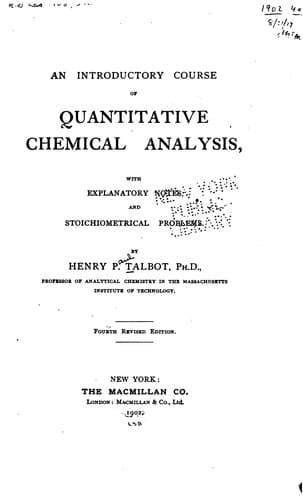
An Introductory Course of Quantitative Chemical Analysis: With Explanatory NotesTalbot, Henry Paul
Science
An Introductory Course of Quantitative Chemical Analysis: With Explanatory Notes
Talbot, Henry Paul
Chemistry, Analytic -- Quantitative
PROCEDURE.--Grind the mineral in an agate mortar until no grit is
perceptible. Transfer the substance to a weighing-tube, and weigh out
two portions, not exceeding 0.20 gram each (Note 1) into two beakers
of about 200 cc. capacity. Pour over them 20 cc. of dilute nitric acid
(sp. gr. 1.2) and warm gently until solvent action has apparently
ceased. Evaporate the solution cautiously to dryness, heat the residue
for about an hour at 100-110°C., and treat it again with nitric acid
as described above; separate the residue of silica by filtration on
a small filter (7 cm.) and wash with warm water, using as little as
possible (Note 2). Receive the filtrate in a beaker (200-500 cc.).
Test the washings with ammonia for calcium phosphate, but add all such
tests in which a precipitate appears to the original nitrate (Note 3).
The filtrate and washings must be kept as small as possible and should
not exceed 100 cc. in volume. Add aqueous ammonia (sp. gr. 0.96) until
the precipitate of calcium phosphate first produced just fails to
redissolve, and then add a few drops of nitric acid until this is
again brought into solution (Note 4). Warm the solution until it
cannot be comfortably held in the hand (about 60°C.) and, after
removal of the burner, add 75 cc. of ammonium molybdate solution which
has been !gently! warmed, but which must be perfectly clear. Allow
the mixture to stand at a temperature of about 50 or 60°C. for twelve
hours (Notes 5 and 6). Filter off the yellow precipitate on a 9 cm.
filter, and wash by decantation with a solution of ammonium nitrate
made acid with nitric acid.[1] Allow the precipitate to remain in the
beaker as far as possible. Test the washings for calcium with ammonia
and ammonium oxalate (Note 3).
[Footnote 1: This solution is prepared as follows: Mix 100 cc. of
ammonia solution (sp. gr. 0.96) with 325 cc. of nitric acid (sp. gr.
1.2) and dilute with 100 cc. of water.]
Add 10 cc. of molybdate solution to the nitrate, and leave it for
a few hours. It should then be carefully examined for a !yellow!
precipitate; a white precipitate may be neglected.
[Note 1: Magnesium ammonium phosphate, as noted below, is slightly
soluble under the conditions of operation. Consequently the
unavoidable errors of analysis are greater in this determination than
in those which have preceded it, and some divergence may be expected
in duplicate analyses. It is obvious that the larger the amount of
substance taken for analysis the less will be the relative loss or
gain due to unavoidable experimental errors; but, in this instance, a
check is placed upon the amount of material which may be taken both by
the bulk of the resulting precipitate of ammonium phosphomolybdate
and by the excessive amount of ammonium molybdate required to effect
complete separation of the phosphoric acid, since a liberal excess
above the theoretical quantity is demanded. Molybdic acid is one of
the more expensive reagents.]
Public-domain text, read in full here on John Shaqi.
Reviews
Reviews
No reviews yet
Be the first to share your thoughts on this work.
Elsewhere in the archive
Join the Discussion
Join the discussion
Sign in to leave a comment or review.
Sign InorCreate an account