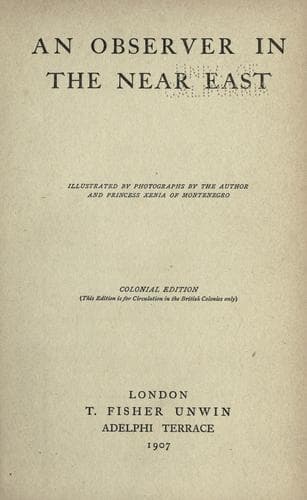
Balkan Peninsula -- Description and travel; Eastern question (Balkan)
It was now already dark. In the trees of the central boulevard thousands
of rooks were cawing and circling above, disturbed by the lights and
movement of the street. Men were shouting the evening newspapers in
strident voices, and one could almost imagine oneself back on the
Boulevard des Italiens at the absinthe hour, with the camelots crying
“_V’la la Presse!_” Only, in Paris, rooks do not nest in the streets,
nor do the watchmakers have twenty-four inches of space and a chair in
the windows of the smaller cafés. A walk along any of the principal
streets at once shows the Bulgar to be a fighter, for the display of
arms of all kinds, even to the modern Browning automatic pistol, is
immense.
Here, one is really in the Balkans. The last official census gives
sixty-six Englishmen and forty-six Englishwomen in the whole of
Bulgaria. I met six only. Uniforms, upon Russian models, are
everywhere—the peaked cap, the grey overcoat, the big revolver. Men in
European dress jostle with peasants in linen blouses, round astrachan
caps, and drab blankets around them, or others in sheepskin jackets with
the wool inside, all with the inevitable round Balkan cap of astrachan.
The Turk, too, is quite at home and friendly with the Christian, and
modern progress is typified by the electric trams whizzing and clanging
everywhere.
[Illustration: Peasants in Sofia Market Place.]
[Illustration: The Old Mosque: Sofia.]
Sofia is essentially a town of progress. During the past eighteen months
whole streets of new villas have sprung up upon its outskirts, and such
a rush has there lately been for building plots that our Foreign
Office—who want to build a new Legation—are unable to get any decent
site in a central position. Sofia is just now in the transition stage.
Great new public buildings and fine boulevards are springing up
everywhere. There is a beautiful new theatre, a new post office, a new
Agricultural Bank, and hosts of minor structures, all spacious and well
built, which, in themselves, show Bulgaria to be a country of rapid
advancement.
Unlike some other Balkan countries, there seems no lack of money here.
Just now, for example, it is proposed to expend a little matter of
fourteen million francs upon roads in the Principality, and the cost of
the new market-halls and other buildings will probably be prodigious.
But the Bulgar is essentially a thrifty person. During the past twenty
years he has transformed his capital from a wretched little Turkish town
into a really handsome city. In twenty years to come, at the present
rate of progress, it will be the Brussels of the East, for it is
modelled upon the same plan.
Public-domain text, read in full here on John Shaqi.
Reviews
Reviews
No reviews yet
Be the first to share your thoughts on this work.
Elsewhere in the archive
Join the Discussion
Join the discussion
Sign in to leave a comment or review.
Sign InorCreate an account