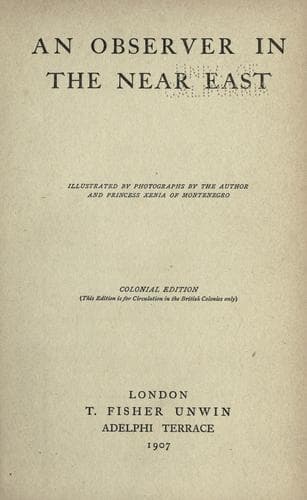
Balkan Peninsula -- Description and travel; Eastern question (Balkan)
I carried letters of introduction to His Excellency Tewfik Pasha, the
Sultan’s Minister of Foreign Affairs; to the Grand Vizier of the Sultan;
to d’Aristarchi Bey, the Grand Logothete; to His Excellency Noury Pasha,
Under-State Secretary for Foreign Affairs; to the British Chargé
d’Affaires, Mr. Geo. H. Barclay—the Ambassador being absent on leave; to
His Excellency Monsieur George Simitch, the Servian Minister; to M.
Dimetri Vlastari, the well-known banker; to Mehemed Ali Pasha; to Riza
Pasha, Minister of War; and to many other of the leading people in the
Turkish capital.
Thus I was enabled to go thoroughly into the present state of affairs. I
was granted an audience of His Majesty the Sultan, as well as by the
Grand Vizier, by Tewfik Pasha, the Khardjie-Naziri, and had many
interviews with the persons named above.
My inquiries were mainly directed to ascertaining—first, what attitude
Turkey was assuming towards Macedonia; secondly, whether the Turks were
alive to the firm intention of Bulgaria for the protection of her
subjects, and in what manner they viewed the prospect of hostilities;
thirdly, the truth about the Macedonian reforms; fourthly, the extent of
German intrigue in Constantinople; fifthly, the Turkish policy towards
Austria; and sixthly, the policy towards Great Britain.
I went to the Porte in order to penetrate the veil of mystery
surrounding diplomacy there, and to get at the true state of affairs.
The task was very difficult, for in the East one is hardly ever told the
real facts about anything. Nevertheless, unique opportunities were
afforded me to obtain knowledge by the absolute facts and the future
aims of both Turkey and Germany—opportunities of which, as will be shown
in the following pages, I was not slow in taking advantage.
In view of the present situation in Turkey, the proclamation of the
“Ottoman Committee of Union and Progress,” which was found posted upon
all the walls of the Pera quarter of Constantinople on January 1 of this
present year, is of great interest in showing the present state of
public feeling in the Turkish capital.
This proclamation, which was issued by a very strong and formidable
party in Turkey, began by stating that Abdul Hamid, after thirty years
of impunity, was now on the verge of death. The fact that now and then
he gives audience of a few minutes’ duration to an Ambassador, or that
at the weekly Selamlik he drives to the mosque, a few yards from his
palace, proves nothing. The Sultan Mahmud fell dead from his horse,
returning from the Selamlik; while the Sultan Medjid was on his feet up
to the very last. In reality Abdul Hamid, knowing the profound effect
which his failure to attend the Selamlik would have upon the people, is
expending all the energies that remain to him in fulfilling this
religious observance and in granting an occasional interview to a
foreign Ambassador.
The proclamation proceeded:—
Public-domain text, read in full here on John Shaqi.
Reviews
Reviews
No reviews yet
Be the first to share your thoughts on this work.
Elsewhere in the archive
Join the Discussion
Join the discussion
Sign in to leave a comment or review.
Sign InorCreate an account