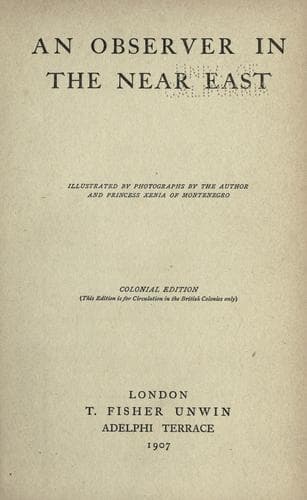
Balkan Peninsula -- Description and travel; Eastern question (Balkan)
“The fact is,” remarked His Excellency presently, smiling as he sat back
in his arm-chair before his littered writing-table, “we Turks are not
understood abroad. Writers in England, and especially your journalists,
not knowing Turkey and never having visited the East, criticise us, and
say all sorts of hard things about Turkish rule and Turkish diplomacy.
They call us intolerant and fanatical. But surely there are evidences in
Constantinople that we are tolerant? We allow Christians to erect
churches wherever they want them; and again, have we not done everything
possible in Macedonia to preserve for its inhabitants their religious
liberty? Really, the English ought to know the truth concerning Turkey.
Unfortunately, the fashion of late seems to be to denounce our land and
all its ways!” And he laughed again.
[Illustration: The entrance to the Bosphorus.]
[Illustration: In Constantinople.]
I referred in guarded words to the possibilities of war with Bulgaria,
whereupon he said—
“We view the matter with perfect tranquillity. The Government of His
Imperial Majesty regrets most deeply those unfortunate incidents in
Macedonia that so constantly occur, but is unable to remedy it. It is
the Greek bands that are to blame—not the Turks.”
“And your diplomatic relations with Bulgaria?” I asked.
“They are perfectly normal,” was his reply. “Dr. Stancioff is an able
Minister, and he fully understands us.”
“Then you do not anticipate hostilities at an early date?” I asked,
pressing home my question.
His Excellency said nothing. He merely shrugged his shoulders. But that
gesture was, to me, sufficiently significant.
“You are going to Macedonia,” he said. “It is not altogether safe, you
know, especially around Presba and Ochrida, or about Seres. But if you
_are_ determined to go, I wish you every good luck on your journey.”
I thanked him, and after another half-hour’s pleasant chat with the
Grand Vizier and Noury Pasha I rose, and Tewfik Pasha grasped my hand
heartily in warm farewell, his parting words being—
“Go, see for yourself, and I believe you will find that we Turks are not
quite so black as we are painted.”
And I left the presence of a man whose broad-minded policy, if it were
adopted in every particular, would, I feel sure, advance the Turkish
cause, and place the Ottoman Empire in a very different position from
what it is to-day.
I crossed the Sea of Marmora to Haidar Pasha, in Asia Minor, visited
Ismid, and saw the new German railway that has its head opposite
Stamboul and is to have its terminus on the Persian Gulf. I went to
Brusa, the ancient capital of the Ottoman Empire, walked in the
wonderful burying-grounds of Scutari, and made many interesting
excursions about Asia Minor, in order to observe the all-powerful
influence of Germany in that country. And I was amazed.
Public-domain text, read in full here on John Shaqi.
Reviews
Reviews
No reviews yet
Be the first to share your thoughts on this work.
Elsewhere in the archive
Join the Discussion
Join the discussion
Sign in to leave a comment or review.
Sign InorCreate an account