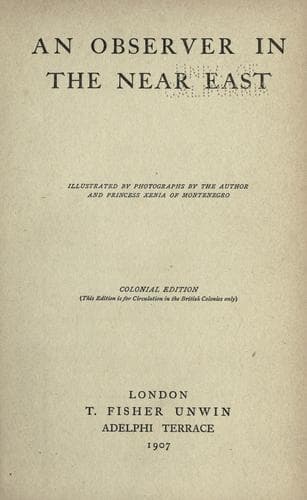
Balkan Peninsula -- Description and travel; Eastern question (Balkan)
I also met several times, and had long conversations with, Dr.
Tartarcheff, who was president of the Macedonian Revolutionary Committee
in Bulgaria, and who, after the insurrection, was taken prisoner by the
Turks. Both men gave me much authentic information and introductions
that were of great use to me in my journey through Macedonia.
The truth is that the Macedonian question is the direct result of the
Treaty of Berlin, for by it the Treaty of St. Stefano—which incorporated
Macedonia in the Bulgarian Principality—was annulled. The Treaty of
Berlin thus left Macedonia under the Turkish dominion, with a provision
of a kind of autonomy under the control of the Great Powers.
This autonomy was worked up in detail by an International Commission in
Constantinople in 1880. But it was not applied, and the situation in
Macedonia remained the same as it was before the Russo-Turkish War, and
became even worse, on account of the Turkish fanaticism aroused against
the Bulgarians as the cause of their military disasters.
The Turkish persecutions and the new situation in Bulgaria attracted the
greater portion of the Macedonian intelligent population into that
Principality. A strong Macedonian emigration was therefore started to
Bulgaria, which in late years has arisen to the number of more than
150,000.
Macedonia, thus drained of its intelligence, devoted its energies from
1880 to 1890 to a strong educational movement, which was favoured in a
great measure by the political circumstances arisen after the union of
Eastern Roumelia to the Bulgarian Principality in 1885. Towards the end
of this period, 1880 to 1890, there had sprung up in Macedonia a young,
vigorous intelligence, with a strong national conscience, longing for
greater freedom in the national and economical development of the
country, and aspiring for a wider field of activity. The Turks, afraid
of the Bulgarian progress, began to restrain the activity of the
Macedonians. The growing tyrannical régime of the Sultan Hamid made the
situation still more difficult, and life became impossible in the
country.
The Macedonians then sought their salvation in revolution.
This revolutionary movement had for its object the autonomy of
Macedonia, which is declared by all I met in the Balkans to be the only
solution of the question.
Public-domain text, read in full here on John Shaqi.
Reviews
Reviews
No reviews yet
Be the first to share your thoughts on this work.
Elsewhere in the archive
Join the Discussion
Join the discussion
Sign in to leave a comment or review.
Sign InorCreate an account